
Following Prime Minister Narendra Modi’s call in the 135th episode of Mann Ki Baat on 28 June 2026 to conserve every drop of rainwater, Odisha has intensified its efforts under the Catch the Rain 2026 campaign, translating public awareness into tangible water conservation outcomes, promoting rainwater harvesting, groundwater recharge, restoration of traditional water bodies, and citizen participation.
Building a Generation of Water Ambassadors
Odisha has adopted a multi-pronged approach that combines community outreach, behavioural change, institutional participation, and the creation of water conservation assets. An extensive public awareness drive was undertaken across the state through 968 Information, Education and Communication (IEC) activities, including street plays, folk performances, community engagement programmes, and awareness campaigns on rainwater harvesting and groundwater conservation. These activities were conducted across multiple districts, with Khordha recording 230 IEC activities, followed by Angul (124); Cuttack, Kendrapara, Jajpur, Sundargarh, Jharsuguda, Nabarangpur, and Subarnapur (62 each); Mayurbhanj (60); Nayagarh and Puri (50 each); and Ganjam (20), demonstrating the campaign’s extensive reach and strong public participation across Odisha.
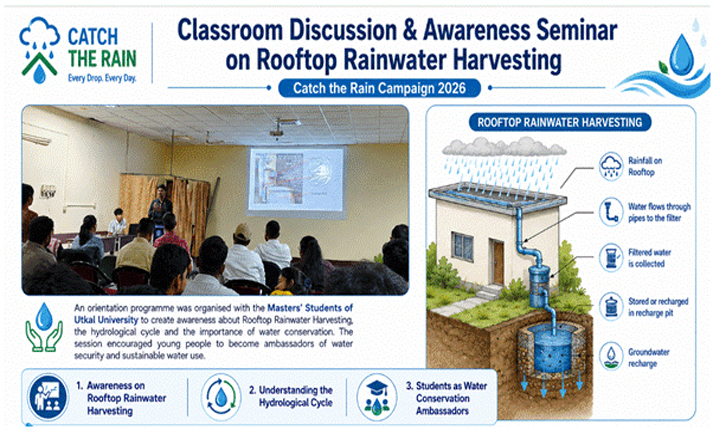
Educational institutions have emerged as important partners in the campaign. Awareness programmes, induction sessions, and technical interactions have introduced students to groundwater science, hydrological processes, and rainwater harvesting systems. These initiatives aim to create informed citizens who can advocate water conservation within their communities and contribute to long-term behavioural change.
Alongside awareness generation, 905 rainwater-harvesting and groundwater-recharge structures have been completed across the state. These include 849 Rooftop Rainwater Harvesting (RRWH) structures, comprising 21 in government buildings and 828 in private buildings, as well as 56 recharge shafts designed to enhance groundwater replenishment. District-wise achievements include 330 RRWH structures in Ganjam, 121 in Khordha, 94 in Mayurbhanj, 62 in Cuttack, 54 in Sambalpur, 53 in Sundargarh, 48 in Kendrapara, 25 in Jharsuguda, 16 in Bargarh, 13 in Puri, 12 in Nayagarh, 10 in Angul, 7 in Nabarangpur, and 4 in Balangir. In addition, 45 recharge shafts were constructed in Jajpur, 10 in Kendrapara, and 1 in Sundargarh, significantly contributing to groundwater recharge efforts under #CatchtheRain
The significance of these figures lies not only in the number of completed structures. They reflect a transition from awareness to adoption. A household that installs a rainwater-harvesting system becomes a participant in local water management.
A recharge shaft creates a link between rainfall on the surface and water stored below the ground. Together, such interventions can strengthen irrigation and local water availability in areas experiencing increasing pressure on groundwater resources.
Reviving Traditional Water Assets
Alongside the creation of new recharge infrastructure, Odisha has prioritised the restoration of traditional water bodies. Under the State Plan’s Improvement to Tanks and Minor Irrigation Projects Scheme, 98 tanks across all 30 districts have been taken up for renovation and desilting.
The restoration of these tanks is enhancing their storage capacity, enabling greater retention of monsoon runoff, supporting irrigation, improving local water availability, and contributing to groundwater recharge. The initiative reinforces the role of traditional water assets in strengthening rural water security and climate resilience.
Strengthening Ecosystems for Water Security
Plantation drives undertaken across irrigation projects, groundwater offices, and water infrastructure sites are complementing water conservation efforts by improving soil stability, reducing erosion, enhancing infiltration, and supporting healthier catchment ecosystems. These measures contribute to the long-term sustainability of water resources while strengthening resilience to climate variability.
A People’s Movement for Water Security
Odisha’s Catch the Rain Campaign demonstrates how community participation can accelerate water conservation outcomes. By combining awareness generation, behavioural change, institutional engagement, restoration of traditional water bodies, and creation of groundwater recharge infrastructure, the state is building a comprehensive framework for sustainable water management.
As the campaign continues, Odisha is reinforcing the principle that water security is most effective when citizens become active participants in conserving, harvesting, and recharging the rain that falls within their communities. The initiative reflects the broader objective of Catch the Rain – transforming seasonal rainfall into a long-term resource for sustainable development and water security.