
Strengthening MSP-Based Price Support to empower farmers
Pradhan Mantri Annadata Aay Sanrakshan Abhiyan (PM-AASHA) is the Government’s flagship price-support framework for remunerative prices for farmers. It includes various schemes to strengthen the implementation of the Minimum Support Price (MSP) and reduce distress sales. Procurement of pulses, oilseeds, and copra is undertaken by the Central and State Governments through agencies such as NAFED and NCCF. With a ₹7,200 crore Budget allocation for 2026–27, PM-AASHA strengthens effective price-support interventions. Digital reforms, including Aadhaar-enabled authentication, e-NAM, e-Samriddhi, and e-Samyukti, have improved transparency and procurement efficiency. Support from the Agriculture Infrastructure Fund and expanded procurement coverage have further strengthened the scheme.
Ensuring Remunerative Prices to Farmers
The government has taken several initiatives to ensure that the benefits of the Minimum Support Price (MSP) reach all farmers, including small and marginal farmers. One major initiative is the Pradhan Mantri Annadata Aay Sanrakshan Abhiyan (PM AASHA). The Government launched the scheme in September 2018. It was designed to ensure remunerative prices for farmers while maintaining price stability for consumers.
PM AASHA brings together multiple price support mechanisms under a unified framework. Each mechanism is implemented according to the crop and market conditions. The scheme strengthens MSP implementation and reduces distress sales among farmers. It also stabilises farm incomes while ensuring food price stability for consumers.
Under PM AASHA, procurement arrangements begin before each marketing season. Central nodal agencies and state governments prepare procurement infrastructure before crops reach the markets. This coordinated approach ensures timely procurement operations and strengthens effective MSP implementation across the country.
Policy design and institutional framework
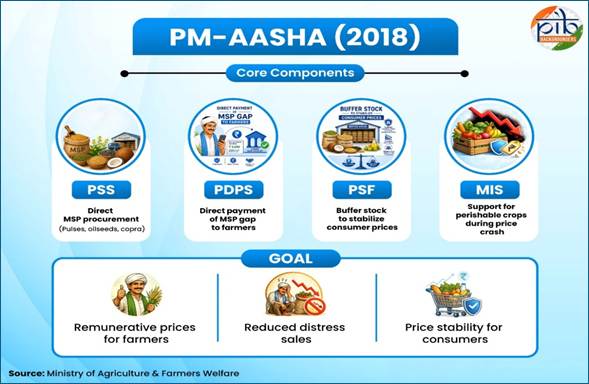
PM AASHA broadly consists of four key components: Price Support Scheme (PSS), Price Stabilization Funds (PSF), Price Deficiency Payment Scheme (PDPS), and Market Intervention Scheme (MIS).
1. Price Support Scheme (PSS)
This scheme ensures procurement of crop at MSP when market prices fall below MSP during harvest. It mainly covers pulses, oilseeds, and copra. Procurement is carried out through agencies such as the National Agricultural Cooperative Marketing Federation of India (NAFED) and the National Cooperative Consumers’ Federation of India Limited (NCCF) at the request of state governments. Only registered farmers with valid land records are eligible, which ensures direct benefit without intermediaries. This helps prevent distress selling and ensures income stability for farmers during price crashes.
From the 2024–25 procurement year, under the Price Support Scheme (PSS), procurement of pulses, oilseeds, and copra is initially allowed up to 25% of a State/UT’s production. Additional procurement beyond this limit may be approved by the Committee of Secretaries up to 25% of national production. However, to boost domestic pulse output and reduce imports, procurement of Tur, Urad, and Masur is permitted up to 100% of State production.
2. Price Stabilization Fund (PSF)
The Price Stabilization Fund (PSF) protects consumers from price volatility by maintaining buffer stocks of essential commodities like pulses, onions, and potatoes. It was set up to stabilize the prices of key agri-horticultural products. Commodities are procured during harvest and released in lean seasons to control price spikes and ensure affordability. PSF is now merged with PM-AASHA but continues to be managed by the Department of Consumer Affairs.
3. Price Deficiency Payment Scheme (PDPS)
Under PDPS, farmers’ produce is not physically procured. Instead, they are paid the price difference between the MSP and the actual market price in the notified market, up to 15% of the MSP value, directly into their bank accounts. This scheme is mainly used for oilseeds and reduces the need for large procurement infrastructure. It promotes market-based selling while still ensuring MSP protection to farmers.
4. Market Intervention Scheme (MIS)
The Market Intervention Scheme (MIS) is designed to procure a range of perishable agricultural and horticultural commodities. It targets products such as tomatoes, onions, and potatoes for which a Minimum Support Price does not apply. The scheme activates when market prices drop by at least 10% over the previous normal season’s rates. It operates through cost-sharing between the Centre and State governments for the operations undertaken by Central Nodal Agencies like NAFED and NCCF. This scheme is especially useful during glut situations when supply exceeds demand.
Enhanced Financial Support Under PM-AASHA
Under the Pradhan Mantri Annadata Aay Sanrakshan Yojana (PM-AASHA), the budget allocation has steadily increased over the years. In 2024–25, the actual expenditure under the scheme was ₹5437.99 crore. The budget increased to ₹6,941.36 crore in 2025–26 and was further raised to ₹7,200.00 crore in 2026-27. This reflects the government’s focus on ensuring income support for farmers and strengthening price assurance mechanisms.
From Cost to Confidence: Strengthening Farmer Remunerative Returns
Higher Minimum Support Prices over production costs strengthen farmers’ income security while encouraging sustained cultivation of key crops, supported by schemes under PM-AASHA. In 2026–27, paddy (common) cost ₹1,627 per quintal, while its MSP was ₹2,441 per quintal, yielding a margin of ₹814. Soybean (yellow) cost ₹3,805 per quintal, while its MSP was ₹5,708 per quintal, yielding a margin of ₹1,903.