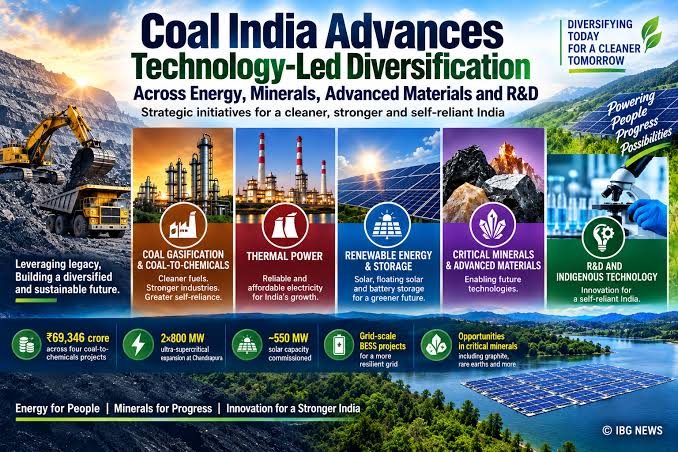

Coal India Limited (CIL) is steadily expanding beyond its conventional coal-mining operations to build a diversified, technology-driven portfolio spanning energy, minerals, advanced materials and research and development (R&D). The company’s Business Development portfolio is organised around five mutually reinforcing platforms: coal gasification and coal-to-chemicals; thermal power; renewable energy and storage; critical minerals and advanced materials; and diversified minerals, including iron ore.
The portfolio already includes projects of national scale, including approximately ₹69,346 crore across four coal-to-chemicals initiatives, a 2×800 MW Chandrapura ultra-supercritical expansion, around 550 MW of commissioned solar capacity, grid-scale Battery Energy Storage System (BESS) initiatives, and opportunities in critical minerals and downstream materials.
Strategic Context and Business Development
CIL’s nationwide footprint, mining and project-development experience, government relationships, land and coal resources, procurement systems, balance sheet and partnership capabilities provide a strong platform for diversification. The guiding principle is “diversification with purpose”—supporting energy and mineral security, import substitution, indigenous technology, low-carbon growth, efficient public-asset utilisation and resilient domestic manufacturing, while maintaining commercial sustainability and risk-adjusted returns.
Coal Gasification, Coal-to-Chemicals and Underground Coal Gasification
Coal gasification converts coal into synthesis gas, or syngas, which can be used to produce synthetic natural gas (SNG), ammonia, urea, ammonium nitrate, methanol and other chemicals. The technology can help unlock chemical value from coal while supporting import substitution.
CIL’s four major coal-to-chemicals initiatives are: Talcher Fertilizers Ltd., with a capacity of 1.27 MMTPA of urea and an estimated project cost of ₹19,062.22 crore; Bharat Coal Gasification & Chemicals Ltd., with a capacity of 0.66 MMTPA of ammonium nitrate and an estimated project cost of ₹25,015.89 crore; Coal Gas India Ltd., with a capacity of 633.6 million Nm³ per year of SNG and an estimated project cost of ₹13,052.81 crore; and the CIL-BPCL Chandrapur coal-to-SNG initiative, with a capacity of 633.6 million Nm³ per year and an estimated project cost of ₹12,214.86 crore.
The technology priorities for these initiatives include adapting processes to high-ash Indian coal, process optimisation, localisation of critical equipment, advanced process control and digital twins, predictive maintenance, and improved water, ash and emissions management. Replication of projects will be pursued only after operating data and commercial performance have been verified.
Underground Coal Gasification (UCG) offers a potential route for converting deep-seated or otherwise unmineable coal into syngas. As the technology has not yet been commercially proven globally, CIL is pursuing a phased pilot project at the Kasta West Block of Eastern Coalfields Limited (ECL). Phase I was completed on 31 May 2025, while Phase II commenced on 20 June 2025. The second phase covers detailed engineering, directional drilling, injection and production wells, and ignition and control systems, with completion scheduled in 2026.
Thermal Power, Solar and Floating Solar
CIL and Damodar Valley Corporation (DVC) are implementing a 2×800 MW ultra-supercritical brownfield expansion at Chandrapura, Jharkhand, through a proposed 50:50 joint venture. DVC will facilitate the sale of power. The future focus areas include high-efficiency generation, predictive maintenance, flexible plant operation, emission controls, water recycling and scientific utilisation of ash.
Approximately 550 MW of solar capacity has been commissioned by CIL, while rooftop, ground-mounted, captive, interstate and market-linked projects are under development. CIL is pursuing two models: captive solar projects to reduce power costs and the carbon footprint, and utility-scale projects for commercial renewable-power generation.
Selection of solar projects will be based on lifecycle and risk-based assessments covering resource quality, transmission, land availability, storage, curtailment, offtake and delivered cost. Digital monitoring and hybrid storage solutions will support project performance and operational flexibility.
CIL is also developing a 20 MW AC grid-connected floating solar project at Chilwa Taal, Gorakhpur. Floating solar offers a land-efficient option for suitable water bodies. However, site-specific assessment and standard screening will be required to address risks related to water levels, bathymetry, wind and waves, anchoring, corrosion, maintenance, safety and ecology.
Battery Energy Storage Systems
Battery Energy Storage Systems (BESS) support renewable-energy integration, peak-demand management, grid flexibility and improved transmission utilisation. CIL’s initiatives include the TGGENCO Choutuppal project in Telangana, with a capacity of 187.5 MW/750 MWh and a four-hour duration. The project has been awarded to CIL, while EPC selection and long-term operation and maintenance arrangements are in progress.
CIL is also developing an Odisha BESS portfolio of 80 MW/320 MWh across four locations, with a four-hour duration. Capacity has been secured through the Solar Energy Corporation of India (SECI), and the EPC tender has been issued.
The commercial success of BESS projects will depend on high availability, dependable state-of-charge management, compliance with dispatch requirements and advance planning for augmentation.
Critical Minerals and the Integrated Graphite Value Chain
Critical minerals are essential for batteries, electric vehicles, renewable-energy systems, electronics, advanced manufacturing, aerospace and defence. CIL’s domestic opportunities include graphite assets in Madhya Pradesh and Chhattisgarh, as well as rare earth element (REE) and rare-metal opportunities in Andhra Pradesh and Maharashtra.
The focus areas include resource definition, geometallurgy, beneficiation, recovery, product specification, waste management and market linkage. These efforts are being supported through collaborations with Indian Rare Earths Limited (IREL), the Non-Ferrous Technology Development Centre (NFTDC), Curtin University, Hindustan Copper and State entities. Overseas opportunities will be evaluated through stage-gated technical and financial due diligence.
CIL aims to establish an integrated graphite value chain covering mining, beneficiation, purification, spheronisation and coating, and the production of anode materials. In collaboration with NFTDC, a demonstration plant for coated spherical purified graphite (CSPG) with a purity of at least 99.95% has been proposed as a qualification platform. Commercial scale-up will follow consistent product quality, process performance and customer qualification.
Digital and Institutional Architecture
A common digital architecture is required across mining, process industries, power, renewable energy, grid services and advanced materials. Key elements will include a secure enterprise data room, standard project financial models, GIS-based opportunity mapping, portfolio dashboards tracking project stage, approvals, investment, schedule, risks and returns, and digital engineering and asset-information requirements from the tender stage.
A common stage-gate model will cover opportunity screening, concept validation, feasibility, contracting, demonstration and commercial operation. CIL will use joint ventures and strategic partnerships to access specialised technologies and markets, with emphasis on technology transfer, localisation, measurable deliverables and time-bound milestones.
Risk Management, Key Performance Indicators and Way Forward
CIL will adopt a proactive, stage-gated approach to risk management covering technology and resource risks; market and financial risks; execution and cost risks; environmental, social and governance (ESG) and supply-chain risks; cyber and operational risks; and capability-related risks.
Risk responses will include pilot validation and independent review; customer qualification and offtake arrangements; robust detailed project reports (DPRs) and contingencies; lifecycle assessment and localisation; operational technology security and incident response; and targeted training and knowledge transfer.
Key performance indicators will cover project delivery, operational availability and quality, renewable-energy capacity in MW and storage capacity in MWh, mineral-resource advancement and downstream qualification, import substitution and indigenous technology, risk-adjusted returns and cash generation, and ESG outcomes relating to emissions, water, waste, restoration, safety and community impact.
The Business Development Division will function as the enterprise integrator for technology-led diversification. Its responsibilities include identifying opportunities, structuring partnerships, validating technologies, establishing commercial models, securing approvals and moving projects into disciplined execution. Immediate priorities include preparing a unified diversification and technology roadmap with accountable sponsors, standard technical, financial and ESG evaluation templates, and demonstration projects with predefined success criteria and independent validation.
Research and Development Initiative at CIL
R&D, Technology and Innovation Ecosystem
CIL’s R&D framework has evolved from the Standing Committee on Science and Technology established in 1975, to the R&D Board constituted in 1994 and the Apex Committee established in 2003. The framework has now progressed to the independent R&D Policy and Guidelines of 2026, which prioritise projects at Technology Readiness Level (TRL) 4 and above.
The thrust areas include mine planning, productivity, safety and exploration; artificial intelligence, machine learning and Internet of Things-based smart mining; environment and sustainability; waste-to-wealth; technology innovation and indigenisation; alternative uses of coal; renewable energy; and clean coal, beneficiation and mineral processing.
R&D governance provides for approvals through the CIL Board, R&D Board, Apex Committee and subsidiary-level R&D committees, depending on project value. NaCCER functions as the independent nodal agency and central hub, supported by a hub-and-spoke network linking CIL Centres of Excellence, IITs and NITs, CSIR laboratories, research institutions, subsidiaries, incubation centres, start-ups and industry partners.
Major Centres of Excellence Supported by CIL
Major CIL-funded Centres of Excellence include the CIL Centre of Sustainable Energy at IIT Madras, supported with ₹87.90 crore and focusing on sustainable materials, mine repurposing and energy transition; CLEANZ at IIT Hyderabad, supported with ₹98 crore and focusing on clean coal technology and low-grade Indian coal; the CIL Centre for Innovation in Mining at IIT (ISM) Dhanbad, supported with ₹67.45 crore and focusing on Mining 4.0, IoT, smart mines, immersive technologies and 5G; and the CII Centre at IIT (ISM) Dhanbad, supported with ₹10 crore and focusing on innovation, incubation, prototyping, virtual reality, simulation and automation.
R&D Portfolio, Expenditure and Achievements
The R&D portfolio comprises 20 individual projects with an approved outlay of ₹231 crore. High-impact initiatives include UCG at Kasta West, 5G captive networks for opencast and underground mines, bifacial perovskite solar cells, and artificial intelligence and geophysical exploration for critical minerals.
R&D expenditure stood at ₹61.31 crore in FY 2023–24, ₹245.38 crore in FY 2024–25 and ₹183.88 crore in FY 2025–26. Planned expenditure is ₹225 crore for FY 2026–27, ₹350 crore for FY 2027–28, ₹400 crore for FY 2028–29 and ₹500 crore for FY 2029–30.
Achievements during FY 2026–27 include the filing of five patents, with two additional patents under process; the grant of one patent for bifacial perovskite solar cells; technology transfer for commercialisation of Velocity of Detonation measurement equipment; and discussions for establishing new CIL Centres of Excellence with IIIT Roorkee and IIT Kharagpur.
The way forward is to strengthen NaCCER, scale up the hub-and-spoke ecosystem, accelerate the movement from research to deployment, and focus on indigenous and future-ready technologies such as gasification, futuristic materials and batteries.
Conclusion
CIL is steadily evolving from a conventional coal-mining enterprise into a diversified energy, minerals, materials and technology-driven organisation. Its initiatives in coal gasification, efficient power generation, renewable energy and BESS, critical minerals, advanced materials and R&D provide a broad foundation for this transition.
Going forward, the focus will be on converting these initiatives into scalable and commercially sustainable outcomes through technology validation, indigenous capability, strategic partnerships, disciplined investment, digital governance and robust risk management. Strengthening NaCCER and the R&D hub-and-spoke ecosystem will further accelerate the transition from research and innovation to field deployment.
With clear stage gates, measurable outcomes and accountable execution, CIL can leverage its mining expertise, institutional capabilities and technology ecosystem to support India’s energy and mineral security, import substitution and technological self-reliance, while creating sustainable new growth platforms for the future.