
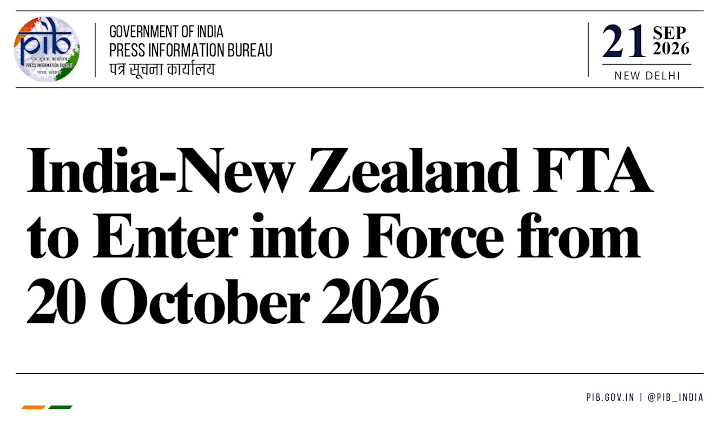

In a defining step forward for trade and economic partnership, the India–New Zealand Free Trade Agreement, is going to enter into force on 20th October 2026. The FTA was signed on 27th April 2026 at Bharat Mandapam, New Delhi, by Union Minister of Commerce and Industry Shri Piyush Goyal and New Zealand’s Minister for Trade and Investment Hon. Todd McClay.
Today, the Union Minister of Commerce and Industry Shri Piyush Goyal and New Zealand’s Minister for Trade and Investment Hon. Todd McClay spoke via virtual conference and announced the date for entering into force of the agreement following the completion of internal processes in both countries. The legislation was passed by the New Zealand Parliament on 16th September, 2026.
Under the visionary leadership of Hon’ble Prime Minister Shri Narendra Modi, India and New Zealand have continued to deepen and expand their engagement. The visit of Hon’ble Prime Minister Shri Narendra Modi Ji to New Zealand in July 2026, the first visit by an Indian Prime Minister to New Zealand in four decades, provided further momentum to the bilateral relationship and emphasised the importance of the early implementation of the India-New Zealand FTA. The visit also marked an important elevation in the relationship, with India and New Zealand announcing a Strategic Partnership and endorsing the India-New Zealand Strategic Partnership: Roadmap to 2030 as a shared framework to guide cooperation over the next four years including an aspirational goal of doubling bilateral two-way trade in goods and services to NZ$7 billion (approximately ₹35,000 crore) by 2030. Operationalisation of the FTA will serve as a key enabler for translating the ambitions of the Strategic Partnership: Roadmap to 2030 into tangible economic outcomes.
Highlighting the significance of the milestone, the Hon’ble Commerce & Industry Minister Shri Piyush Goyal said “ The India-New Zealand FTA would provide fresh momentum to the bilateral partnership, create greater synergies between the two economies, enable economies of scale and contribute to enhancing overall competitiveness”. Emphasising the symbolism of the chosen date, he said, “We have chosen the auspicious day Dussshera- Vijay Dashmi for the entry into force of the India-New Zealand FTA. I am confident that the entry into force will overcome all hurdles that stood between our trade, technology and investment relationship, and will ensure prosperity for people of both sides”.
Hon. Todd McClay, Minister for Trade and Investment, noted that at a time of uncertainty in trade and rising tariffs, India New Zealand FTA gives confidence. With hard work, we have delivered one of the highest quality agreements concluded in nine months, which will provide tangible benefits to businesses and stakeholders on both sides. He highlighted that the Agreement is a great foundation for both Governments to cooperate in greater areas, be it people-to-people cooperation, culture, sports, business or investment and we will work together to address challenges faced by businesses to create greater employment opportunities on both sides.
From the entry into force, every single tariff line covering 100% of India’s exports to New Zealand becomes duty-free, offering Indian industry a level playing field that puts it on par with New Zealand’s other trading partners. Sectors that power livelihoods across the country – textiles and apparel, leather and footwear, gems and jewellery, engineering goods and processed foods – stand to gain immediately as New Zealand’s peak tariffs of up to 10% are eliminated. Indian manufacturers will also benefit from tariff-free access to critical inputs such as wooden logs, coking coal and metal scrap, sharpening their competitive edge in global markets.
At the same time, the Government has safeguarded the interests of Indian farmers by keeping sensitive products such as dairy, animal meat (except sheep), key agricultural commodities, sugar and edible oils excluded from tariff concessions. A calibrated market access has been structured for New Zealand’s apples, kiwifruit and Manuka honey through Tariff Rate Quotas with Minimum Import Price and seasonal import windows, alongside safeguards to protect domestic farmers. The Agreement establishes an Agriculture Productivity Partnership to strengthen cooperation in agriculture, with dedicated Action Plans for kiwifruit, apples and honey aimed at improving productivity, quality and farmer incomes in India. Centres of Excellence will be established for orchard management, post-harvest practices, supply chains, food safety and sustainable beekeeping, facilitating the exchange of knowledge, technology and capacity. A Joint Agriculture Productivity Council will monitor that the market access is complemented by cooperation activities by New Zealand under Agriculture Productivity Partnership.
The FTA also sets the stage for deeper investment gains for India, with New Zealand’s commitment to facilitate USD 20 billion in investment into India. This investment by New Zealand will benefit Indian agriculture, manufacturing, infrastructure and start-ups.
For India’s rapidly growing services sector, the Agreement creates a stronger platform for Indian companies and professionals to access the New Zealand market and expand their international footprint spanning roughly 118 sectors including IT, professional services, audio-visual, construction and tourism, with Most-Favoured Nation treatment locked in across about 139 sub-sectors, mobility opportunity through a dedicated quota of 5,000 Temporary Employment Entry visas for skilled Indians and 1,000 Working Holiday visas each year for young Indians. The agreement also provides uncapped student mobility with post-study work rights of up to three years for STEM graduates and four years for doctoral scholars.
India’s pharmaceutical and medical device exporters gain a long-awaited edge as New Zealand begins accepting inspection approvals from globally trusted regulators such as the US FDA, EMA, UK MHRA and Health Canada, cutting long waiting time and speeding up market entry.
With bilateral merchandise trade already at around USD 1.1 billion in 2025-26, the entry into force of the India-New Zealand FTA is set to give a decisive push to two-way trade, investment and job creation in the years ahead. Anchored in the vision of Viksit Bharat @2047, the Agreement stands as another testament to India’s growing network of partnerships with developed economies – one that places farmers, women, youth, artisans and MSMEs at the very heart of its gains.