
Transforming Agriculture Through District-Level Action
India’s agriculture sector has significant potential across diverse regions and farming communities. However, despite rich potential, many areas face challenges like low productivity, inadequate irrigation, limited access to credit, and lack of post-harvest infrastructure. As a result, these areas are not able to attain their full agricultural potential and lag behind in economic development.
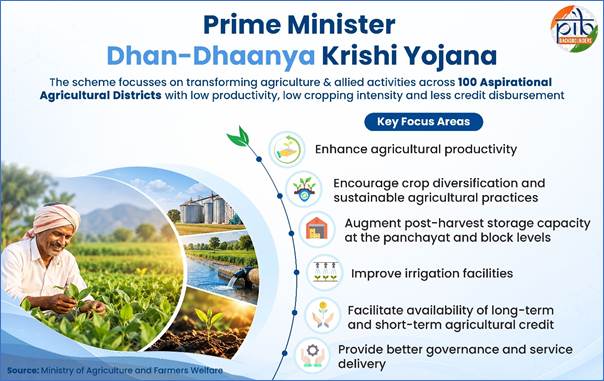
PM Dhan-Dhaanya Krishi Yojana (PMDDKY) seeks to address these gaps, and develop 100 Aspirational Agricultural Districts through focused intervention. By addressing district-specific needs the scheme can help unlock opportunities in productivity, irrigation, credit access, and post-harvest infrastructure. PMDDKY was approved by the Union Cabinet on 16th July, 2025 for a period of six years, and was formally launched by Hon’ble Prime Minister on 11th October, 2025. It celebrates its first anniversary on 11th October this year.
The six-year initiative, beginning with 2025-26, focuses on transforming agriculture and allied activities across 100 Aspirational Agricultural Districts. These districts were identified using three key indicators: low productivity, low cropping intensity, and less agricultural credit disbursement. The selection also considered the share of net cropped area and operational holdings in each State and Union Territory. Each State has at least one selected district.
The scheme is being implemented through the convergence of 36 Central schemes across 11 Ministries and Departments, State schemes and private sector participation, enabling interventions suited to local agricultural priorities.
Administrative Structure for Implementation
The PMDDKY scheme follows a three-tier implementation structure-
District Level: The District Dhan Dhaanya Krishi Yojana Samiti, headed by the District Collector/DM, prepares and implements the District Action Plan.
State Level: The State Dhan Dhaanya Krishi Yojana Samiti, headed by the Chief Secretary of the State, reviews and monitors the District Plans.
National Level: Two committees oversee the scheme. The National Executive Committee is headed by the Union Minister for Agriculture and Farmers Welfare. The National Monitoring Committee is headed by the Secretary, DA&FW.
District Action Plans
District Action Plans (DAPs) are prepared based on the baseline and diagnostic analysis. The plans identify local agricultural needs and address them by converging relevant Central and State schemes. DAPs sets outcome-based targets, annual milestones, and interventions linked to relevant schemes.
DAPs are sent to the concerned State departments for incorporation into the respective annual action plans. This enables necessary approvals and fund release.
Progress is tracked through 121 indicators across 36 schemes, comprising 74 output and 47 outcome indicators. District performance on output indicators is ranked monthly through the PM-DDKY dashboard-https://pmddky.niti.gov.in/.
A Year of Implementation and Progress
The PMDDKY dashboard became operational in the last week of October 2025. Monthly output-indicator rankings began in November 2025, providing a mechanism for monitoring progress across the 100 districts.
All the 100 DDKY districts have prepared DAPs and it is under implementation.
Committees were constituted at the State, District, and national levels for review and monitoring.
All 100 districts submitted data against output indicators up to August 2026. All 100 districts also submitted outcome indicator data for the financial year 2025-26.
Central Nodal Officers are regularly reviewing the progress and guiding the districts.
Department of Public Enterprises has included adoption of DDKY districts for CSR activity by CPSEs for the FY 2026-27 and 2027-28.
The average score of the 100 districts across the six objectives increased from 18.85 in April 2026 to 46.89 in August 2026, an improvement of 28.04 points.
Objective-wise average scores also recorded improvement during the same period-
Enhancing Agricultural productivity: 1.50 to 8.08
Encouraging Crop diversification and sustainable agricultural practices: 4.08 to 10.18
Augmenting post-harvest storage capacity: 2.14 to 5.19
Improving irrigation infrastructure: 1.38 to 4.91
Enabling greater access to short-term and long-term agricultural credit: 2.40 to 6.53
Better governance & service delivery: 7.41 to 12.05
The first year also created platforms for farmers and Farmer Producer Organisations (FPOs) to exchange experiences and explore new opportunities. The PM-DDKY FPO Sangam, held in December 2025, brought together over 72 FPOs from 15 States and 33 PM-DDKY districts. The event featured experiences on productivity, market access and income enhancement. It also covered natural farming, oilseeds, beekeeping, protected cultivation, micro irrigation, institutional finance and digital agriculture.