
From Import Dependence to Self-Sufficiency
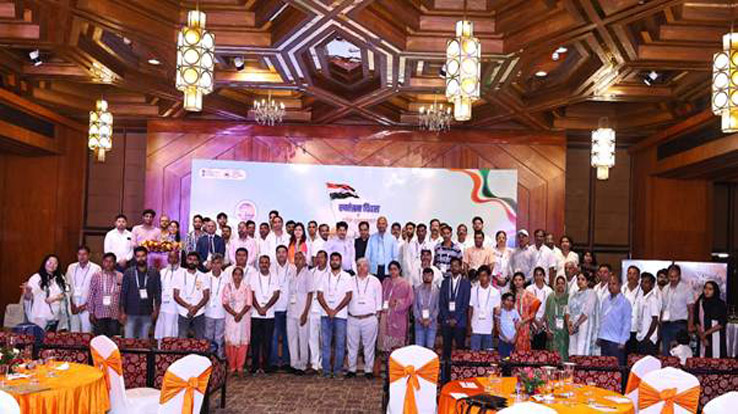
India is the world’s largest producer of pulses, a globally important, protein-rich food crop. Pulses contain 20-25% protein, more than double that of wheat and nearly three times that of rice. Pulses contribute significantly to India’s agricultural exports and remain a vital part of Indian diets, ensuring nutritional security. Recognising this importance, the government launched the ‘Mission for Aatmanirbharta in Pulses’ on October 11, 2025. As the nation observes the first anniversary of the Mission’s launch on October 11, this landmark initiative continues its momentum, backed by a financial allocation of ₹11,440 crore spanning 2025–26 to 2030–31. The Mission seeks to achieve self-sufficiency in pulses production. It focuses on boosting domestic production, reducing import dependence, and enhancing farmers’ income through a comprehensive value-chain approach.
A Mission with a Clear Target
Under the Mission, by 2030-31, production is expected to reach nearly 350 lakh tonnes, with yield rising to 1,130 kg per hectare. Key strategic measures driving these targets include:
Focus on enhancing production of Tur, Urad and Masoor
Promotion of climate-resilient seeds and improved seed quality
Distribution of 87.5 lakh free seed kits and 126 lakh quintals of certified seeds over six years
Expands pulse cultivation area by 35 lakh hectares to reach a total targeted area of 310 lakh hectares by 2030–31.
Cluster-based approach covering 489 districts to intensify production
Establishment of 1,000 processing units (dal mills)
Assured procurement of Tur, Urad and Masoor via NCCF and NAFED from willing and registered farmer.
Expected to reduce import dependence and conserve foreign exchange
India’s Pulse Powerhouse
India’s pulse sector showed strong growth in domestic production, farming area, and crop yield during 2025-26. Steady agricultural progress and strong local output continue to strengthen the nation’s pulse economy.
India’s total pulse production rose to 274.09 lakh tonnes in 2025-26 (3rd Advance Estimates) from 256.83 lakh tonnes in 2024-25.
India’s pulse cultivation area expanded significantly from 277.20 lakh hectares in 2024-25 to 286.46 lakh hectares in 2025-26.
The major regions of Pulse cultivation are Madhya Pradesh, Maharashtra, Rajasthan, Uttar Pradesh, Gujarat, Andhra Pradesh, Karnataka, Jharkhand, Odisha and West Bengal.
National pulse productivity improved as the overall yield increased from 926 kg per hectare in 2024-25 to 957 kg per hectare in 2025-26.
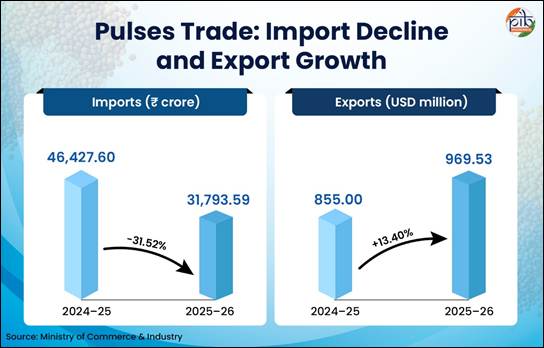
India’s pulses imports declined by 31.52%, from ₹46,427.60 crore in 2024-25 to ₹31,793.59 crore in 2025-26.
India’s pulses exports rose 13.40%, from USD 855 million in 2024-25 to USD 969.53 million in 2025-26. The total export volume reached a total volume of 10.01 lakh tonnes during 2025–26.
In 2025-26, major export destinations included China, UAE, Bangladesh, the U.S.A., and Sri Lanka.
Rising MSP, Assured Procurement
The government continues to strengthen price security for pulse farmers through substantial increases in Minimum Support Prices. Higher support prices ensure fair returns and incentivize increased domestic production of key pulse crops.
For the marketing season 2024-25, the Minimum Support Price (MSP) for Urad was fixed at ₹7,400 per quintal, which was increased by ₹800 (10.81%) to ₹8,200 per quintal for 2026-27.
For the year 2024-25, the MSP for Tur (Arhar) stood at ₹7,550 per quintal, which saw an enhancement of ₹900 (11.92%) to reach ₹8,450 per quintal in 2026-27.
For the year 2024-25, the MSP for Masur (Lentil) was set at ₹6,700 per quintal, which was revised upward by ₹300 (4.48%) to ₹7,000 per quintal for 2026-27.