
Small hydropower uses the natural flow of rivers and canals to generate clean, reliable electricity. In India, projects with capacity up to 25 MW fall within this category. They suit hilly, remote areas where terrain limits larger projects and grid reach. India has an identified potential of 21,134 MW across 7,133 sites, of which about a quarter is harnessed. These projects need little land, cause minimal displacement and offer a long operational life. With sustained policy support, small hydropower can strengthen energy access across India’s underserved regions.
Introduction
Hydropower, generated from the natural flow of water, is among the world’s most reliable and established renewable energy sources. Amid India’s evolving energy landscape, it plays a pivotal role in ensuring grid stability, energy security, and power system resilience. Hydropower provides firm, round-the-clock electricity alongside operational flexibility. As India accelerates its transition towards a cleaner energy mix, hydropower remains an important pillar of sustainable electricity generation.
Small Hydropower (SHP), comprising projects with installed capacity up to 25 MW, offers significant opportunities for harnessing India’s untapped water resources. With substantial potential across Himalayan states, the North Eastern region, and other parts of the country, small hydro projects can contribute meaningfully to India’s renewable energy capacity. Recognising this potential, the Government of India has introduced various initiatives to promote small hydropower development, encourage investment, and harness untapped resources. These efforts aim to expand clean energy generation while improving electricity access in remote and geographically challenging regions.
Beyond electricity generation, small hydropower offers several developmental and economic benefits. Compared with large hydroelectric projects, these installations generally require smaller land areas and can have relatively limited environmental footprints. They can promote local investment, generate employment, strengthen regional infrastructure, and support economic activities in remote areas. By complementing other renewable energy sources and diversifying the country’s energy portfolio, small hydropower can contribute to India’s energy security and sustainable development objectives.
Did You Know?
In India, the primary distinction between large and small hydropower projects lies in their installed capacity and the respective ministerial jurisdiction. Small Hydropower Projects (SHP) are defined as those with an installed capacity of up to 25 MW and are administered by the Ministry of New and Renewable Energy (MNRE). In contrast, large hydropower projects, with capacity exceeding 25 MW, fall under the purview of the Ministry of Power.
Government Initiatives for Small Hydropower Development
The Ministry of New and Renewable Energy (MNRE) is the nodal ministry responsible for promoting small hydro projects. The Government of India has recently approved the Small Hydro Power (SHP) Development Scheme for FY 2026–27 to FY 2030–31, with an outlay of Rs. 2,584.60 crore. The scheme aims to add approximately 1,500 MW of small hydro capacity. It prioritises hilly, North-Eastern and border regions through financial assistance, project preparation support and technical capacity building.
The scheme outlines a set of targeted measures to support implementation, improve project viability, and ensure a steady pipeline of SHP projects across regions. It focuses on addressing key constraints related to financing, project readiness, and execution, particularly in challenging geographies. Together, these measures are intended to enable faster and more efficient deployment of SHP capacity.
Financial Support Structure:
Financial assistance to North Eastern States & International Border Districts of Rs 3.6 crore per MW or 30% of project cost (whichever is lower), subject to a ceiling of Rs 30 crore per project.
Financial assistance to other locations of @ Rs 2.4/1.78/2.054 crore per MW (depending on the size and location of the project) or 20% of project cost (whichever is lower), with a cap of Rs 20 crore per project.
Investment and Economic Impact:
The scheme is expected to attract investments of around Rs 15,000 crore in the small hydro sector.
It will also promote the use of indigenous plant and machinery, contributing to the vision of Atmanirbhar Bharat while boosting local manufacturing and supply chains.
Pipeline Development and DPR Support:
To ensure long-term sector growth, the scheme provides support for the preparation of Detailed Project Reports (DPRs) for a minimum of 200 projects. An allocation of Rs 30 crore has been made separately to assist central and state agencies in developing a strong future project pipeline.
Employment Generation:
The scheme is expected to generate approximately 51 lakh person-days of employment during the construction phase. In addition, it will create sustained employment opportunities in the operation and maintenance of projects, particularly in rural and remote regions.
The approval of the SHP Development Scheme marks a significant step towards unlocking India’s untapped small hydro potential. By combining targeted financial support, infrastructure development, and sustainability, the scheme is set to strengthen clean energy capacity while driving inclusive growth in underserved regions.
Significance of Small Hydro Power for Sustainable Energy Development
Small hydro power plays a vital role in advancing clean, reliable, and decentralised energy in India. Particularly suited for remote and hilly regions, these projects utilise locally available water resources to generate electricity close to consumption centres. This not only improves energy access but also reduces dependence on long transmission networks and enhances overall efficiency.
Decentralised and Efficient Power Supply: Located near demand centres, these projects minimise transmission losses, improve voltage stability, and ensure reliable power in geographically challenging areas, including border and hilly regions.
Clean and Cost-Effective Energy Source: Small hydro power generates electricity without fuel consumption or emissions, making it a sustainable and economically viable long-term solution.
Driver of Rural Development: By improving electricity access in underserved areas, these projects support infrastructure development and act as a catalyst for local economic growth.
Employment and Livelihood Generation: They create both direct and indirect employment opportunities during construction and operation, while also promoting small-scale industries and self-employment.
Environmentally Sustainable: With minimal land requirement and negligible displacement, small hydro power projects have a low ecological footprint and limited social impact. Their long operational life further strengthens their sustainability.
SHP offers a balanced solution that combines energy security with sustainable development. By delivering reliable, round-the-clock power and strengthening grid resilience, especially in remote areas, they contribute significantly to inclusive growth. Their ability to integrate environmental sustainability with socio-economic benefits makes them a key component of India’s clean energy transition.
SHP is emerging as a vital and reliable component of India’s clean energy transition. It is particularly well-suited for hilly, remote, and difficult terrains where decentralised generation can deliver sustainable power, enhance energy access, and support local livelihoods. India possesses a significant SHP potential of 21,134 MW across 7,133 identified sites. As of 30 September 2026, approximately 5,182 MW (around 25%) has already been harnessed, demonstrating steady progress. The remaining 15,952 MW represents a substantial opportunity for accelerated development through focused policy support and public-private collaboration.
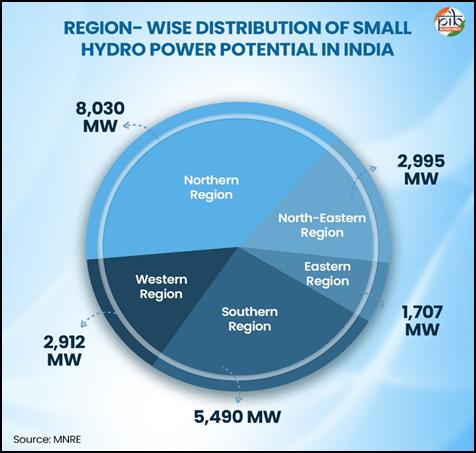
The regional distribution of this potential further reflects India’s rich geographical diversity and offers unique strengths across the country. The Northern region has 8,030 MW of SHP potential, particularly across mountainous terrains. The North-Eastern region holds 2,995 MW, positioning it as a key frontier for expansion, especially in hilly regions and the North Eastern States. The list is followed by Southern region with 5,490 MW of SHP, supported by well-developed river systems and infrastructure. The Western region has a potential of 2,912 MW of SHP, while the Eastern region accounts for 1,707 MW with strong potential in rural and tribal areas.
This distributed potential allows for a balanced, region-specific strategy. While the Northern and North-Eastern regions offer large untapped resources, the Southern and Western regions are better positioned for quicker implementation due to stronger infrastructure. With the recently approved Small Hydro Power Development Scheme, the Government of India is committed to harnessing this diverse potential through targeted incentives, simplified procedures, and enhanced financial support.
By adopting a focused yet inclusive approach, India is poised to unlock the full benefits of small hydropower, strengthening energy security, promoting inclusive growth, and advancing the nation’s goal of a sustainable and self-reliant energy future.