
Rural tourism is emerging as an important avenue for strengthening village economies, generating livelihoods and promoting sustainable tourism in India. The Government’s National Strategy and Roadmap for Development of Rural Tourism focuses on developing village tourism clusters, improving infrastructure, promoting local experiences and encouraging community participation. Initiatives such as Swadesh Darshan, the Best Tourism Villages Competition and the Rural Tourism Village Portal support destination development and promotion. Rural homestays are receiving targeted support through DA-JGUA, MUDRA loans and skill development programmes, creating opportunities for local entrepreneurship, particularly among women and youth. The Government also launched Travel for LiFE in 2023 to promote sustainable practices among tourists and tourism enterprises. These efforts aim to strengthen community-based tourism while preserving rural heritage, traditional livelihoods and natural resources.
Introduction: Rural Tourism in India
India’s villages offer considerable potential for tourism, with their distinctive traditions, handicrafts, agricultural practices, natural attractions and cultural heritage. Beyond established tourist destinations, villages offer opportunities for experiential travel through farm visits, traditional craft workshops, local cuisine, cultural activities and community-run homestays.
Rural tourism presents an opportunity to diversify tourism activity while creating new sources of income within villages. It connects visitors with local communities and supports tourism-related activities such as hospitality, handicrafts, agriculture and guiding services. This approach also encourages the preservation of traditional occupations and cultural practices.
Recognising this potential, the Government formulated the National Strategy and Roadmap for Development of Rural Tourism in India in December 2021, as an initiative towards Aatmanirbhar Bharat. The strategy focuses on developing rural tourism clusters, improving digital access and destination promotion, strengthening local skills and entrepreneurship, and encouraging community participation. It also emphasises coordination between Central and State Government schemes to support rural tourism infrastructure and services.
The strategy provides a framework for developing villages as sustainable tourism destinations, with local communities participating in tourism activities and the economic opportunities they generate.
Impact and Outcomes: Strengthening Rural Economies
Rural tourism creates opportunities for economic activity beyond agriculture by linking village households, local producers and traditional occupations with the tourism market. Its significance lies in the participation of local communities in providing accommodation, food, guided experiences, handicrafts and other visitor services.
The benefits are particularly relevant to villages where existing cultural and agricultural resources can support tourism without replacing traditional livelihoods. Villages that build on these resources have won global recognition: Pochampally in Telangana was named a Best Tourism Village by the United Nations World Tourism Organization in 2021, and Dhordo in Gujarat in 2023.
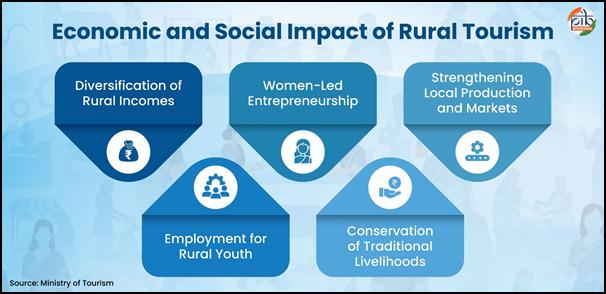
Economic and Social Impact
Diversification of rural incomes: Homestays, farm tourism and village experiences provide additional earning opportunities for agricultural households, artisans and local entrepreneurs. Growth in homestays also raises demand for farm produce.
Women-led entrepreneurship: Community-based tourism creates opportunities in food preparation, homestay management, handicrafts and local experience programmes. Women’s self-help groups can also participate in tourism supply chains, supplying food, souvenirs and services.
Strengthening local production and markets: Direct linkages between tourism establishments and village producers can create demand for locally grown vegetables, traditional foods, handloom products and handicrafts. This helps extend tourism expenditure into agriculture and village enterprises.
Employment for rural youth: Local guiding, hospitality, transport, cultural activities and digital tourism services offer opportunities for self-employment and skills development within rural destinations.
Conservation of traditional livelihoods: Tourism experiences built around weaving, pottery, local festivals and agricultural practices can create additional markets for traditional occupations while encouraging their continuation.
These are the principal channels through which rural tourism can contribute to local development. Homestays show the effect most clearly. The Tourism Satellite Account of India gives the homestay sector the highest employment and output multipliers among tourism sub-sectors, 4.38 and 2.04, and each unit rise in homestay output adds 0.42 units to agricultural output.