
Preserving the Past, Enriching the Future
Strengthening India’s Cultural Identity
India’s rich cultural legacy reflects its civilizational heritage and national identity. It has strengthened heritage conservation through digitisation, tourism infrastructure, and cultural preservation. The Government has undertaken major initiatives to preserve, promote, and revitalise India’s cultural assets. These efforts have strengthened tourism, connectivity, visitor facilities, and local economic development while safeguarding the nation’s cultural identity.
Enhancing Heritage Preservation
Adopt a Heritage 2.0
The Adopt A Heritage 2.0 scheme was launched in September 2023 to develop and maintain visitor-friendly amenities at Protected Monuments of National Importance.
As of March 2026, a total of 30 Memorandums of Understanding (MoUs) have been signed under the Adopt a Heritage 2.0 programme.
Recorded strong visitor participation at adopted monuments, with a total footfall of 13.59 million visitors during FY 2024–25.
Pilgrimage Rejuvenation and Spiritual, Heritage Augmentation Drive (PRASHAD)
The PRASHAD scheme focuses on developing pilgrimage and heritage destinations by improving infrastructure, sanitation, safety, and visitor amenities.
Total 54 projects have been sanctioned across 28 States and Union Territories (as of February 2026).
Projects Completed: 32 (as of December 2025)
Total Project Cost: Rs. 1,726.74 crore.
Swadesh Darshan
Swadesh Darshan, seeks to develop an integrated tourism infrastructure across thematic tourist circuits.
Tourism Circuits Covered: The 15 thematic tourist circuits covered under the Swadesh Darshan scheme are the Buddhist, Coastal, Desert, Eco, Heritage, Himalayan, Krishna, North-East, Ramayana, Rural, Spiritual, Tirthankar, Tribal, Wildlife, and Sufi circuits.
Total 76 Projects has been Sanctioned (as of March 2026), with a total Investment Rs. 5,290.33 crore.
Projects Completed: 75 (as of March 2026).
Under Swadesh Darshan 2.0, the focus has moved beyond circuit-based development to adopt a destination-centric approach.
Under this scheme, 53 projects have been sanctioned with a total investment of Rs. 2,208.31 crore, which are at various stages of implementation by States and Union Territories.
Challenge Based Destination Development (CBDD)
Challenge Based Destination Development (CBDD), introduced in March 2024 under Swadesh Darshan 2.0.
The scheme focuses on developing sustainable tourism destinations through a competitive, challenge-based framework.
Focus Areas: Holistic planning, innovation, community participation, and destination development.
Total no. of Projects Sanctioned are 38, with a total Investment of ₹697.94 crore.
Archaeology and Monument Preservation
Archaeological Survey of India
The Archaeological Survey of India is a premier organization for archaeological research and conservation of India’s cultural heritage.
ASI carries out its functions through a network of around 38 Circles, across the country.
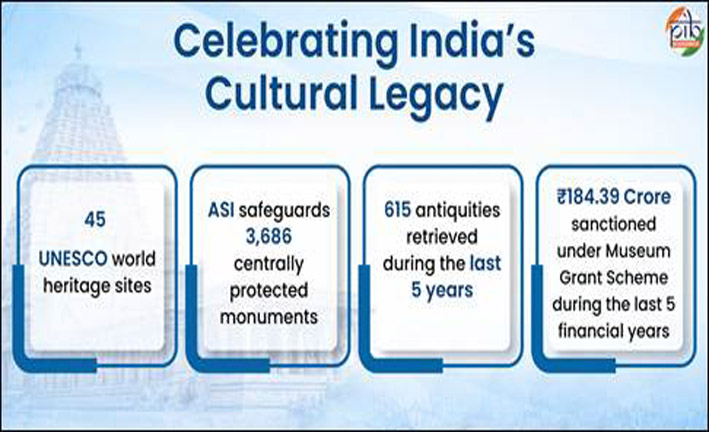
Safeguards 3,686 centrally protected monuments, supported by strengthened conservation systems and scientific restoration methods (as of April 2026).
Rs. 374 crore was allocated for the conservation and maintenance of protected monuments (FY 2024–25).
Over the last five years, the Archaeological Survey of India (ASI) has issued 121 permissions for archaeological projects across the country.
National Mission on Monuments and Antiquities (NMMA)
National Mission on Monuments and Antiquities (NMMA) is implemented by the Archaeological Survey of India (ASI).
NMMA focuses on creating a comprehensive national database of monuments and antiquities to support conservation planning and management.
As of March 2026, the mission has documented 1.84 lakh Monuments and 17.20 lakh Antiquities across India.
HRIDAY Scheme
Heritage City Development and Augmentation Yojana (HRIDAY)
HRIDAY focuses on integrating urban development with heritage conservation while preserving the unique character of heritage cities.
The scheme also focuses on rejuvenation of water bodies and green spaces, smart technology and safety enhancements, and the boosting of local livelihoods through tourism.
Coverage: 12 heritage cities across India.
Key Outcomes:
Improved cleanliness, tourism and community development in Ajmer, Amaravati and Badami.
Promoted heritage revitalisation, inclusivity and economic growth in Amritsar, Gaya and Varanasi.
Enhanced tourism infrastructure and public amenities in Warangal and Puri.
Strengthened safety and urban infrastructure in Kancheepuram and Mathura.
Advanced environmental sustainability and heritage conservation in Velankanni.
Developed comprehensive heritage zones, processional streets, CCTV networks, and the Bet Dwarka Darshan Circuit in Dwarka.
Overall Impact: Improved quality of life for residents and strengthened tourism potential.
Mission Period: Concluded on 31 March 2019.
Reclaiming India’s Cultural Treasures
The Government has intensified efforts to repatriate sacred relics and antiquities taken abroad through colonial exploitation, foreign occupations, and illegal trafficking.
Repatriation of Sacred Relics
Major repatriation achievements include:
Piprahwa Relics of Lord Buddha returned in 2025 after 127 years
Goddess Annapurna idol repatriated from Canada in 2021 after 108 years
Rama, Sita, and Lakshmana bronze idols returned from the UK in 2020
Sacred and cultural objects have also been returned from Australia, the USA, the UK, Germany, Singapore, and Canada.
Global Exposition of Sacred Relics:
India expanded the international exposition of sacred Buddha relics to strengthen cultural and civilizational ties.
Vietnam (2025): Attracted over 15 million devotees
Kalmykia, Russia (2025): Welcomed over 90,000 visitors
Bhutan (2025): Featured an exposition during the Global Peace Prayer Festival
Sri Lanka (2026): Featured an exposition at the Gangaramaya Temple, Colombo
Domestic exhibitions were also organised in New Delhi and Ladakh in 2026, showcasing the reunited Piprahwa relics.
Repatriation of Antiquities
Number of antiquities retrieved during the last five years: 615 (up to 30 June 2026)
Verified Objects Handed Over: 11 to concerned organisations and institutions
09 objects have been given on loan to Indira Gandhi National Centre for the Arts (IGNCA) for display at the New Parliament Building, 01 object to the National Museum, and 14 objects to the Indian Institute of Heritage.
Museums and Cultural Infrastructure
Museum Grant Scheme
The Museum Grant Scheme provides financial assistance for establishing new museums and strengthening existing museums at the regional, state, and district levels.
Support Areas: Modernization, digitization of museum collections, and capacity building of museum professionals.
Under this scheme, various initiatives have been undertaken to develop virtual museums, theme-based museums, and Virtual Experiential Museums (VEMs).
Total Sanctioned Amount during the last five financial years: Rs. 184.39 Crores
Total Utilized Fund during the last five financial years: Rs. 101.19 Crores
India’s First Archaeological Experiential Museum-Vadnagar, Gujarat
The ‘Archaeological Experiential Museum’ is the only museum in the world where history and excavation come together.
Spread over an area of 12,500 square meters and built at a total project cost of ₹298 crore
The museum displays over 5,000 artefacts, including food grains, DNA samples, and skeletal remains.
It also features a 4,000 sq. m. open excavation site showcasing archaeological remains at 16–18 metres depth.
An experiential walkway enables visitors to observe archaeological findings unearthed during excavations.
Global Recognition Through UNESCO
India has significantly expanded its global heritage recognition over the past decade.
India now has 45 UNESCO World Heritage Sites.
India hosted the 46th UNESCO World Heritage Committee Session in New Delhi (2024).
Preserving Knowledge Through Digitisation
Digitisation of Cultural Heritage (Gyan Bharatam)
Gyan Bharatam Mission
Mission was launched in 2025, with a focus on preserving, digitizing, and promoting access to India’s manuscript heritage.
Technology Integration: Modern technologies are adopted for long-term preservation and global accessibility.
National Manuscript Survey
National Manuscript Survey launched in March 2026 with the aim to identifying, documenting, and creating a comprehensive national database of manuscripts.
During this survey, more than 1.19 crore manuscripts have been reported.
The total number of digitized manuscripts available across the country is over 8 lakh, out of which, more than 4.40 lakh manuscripts are available on Gyan Bharatam portal at present for public access.
Mission approved with an outlay of ₹482.85 crore (2024–31) to scale digitization and access.
Digitisation of Museum Collections
The Ministry of Culture is digitising museum collections and archival resources through JATAN software, developed in technical collaboration with C-DAC, Pune, Maharashtra.
A National Digital Repository has been created through the Museums of India portal to provide digital access to museum collections.
The portal hosts digitised collections from 8 National Level Museums, 2 ASI Site Museums, and Dr. Babasaheb Ambedkar Museum, Pune, Maharashtra.
3,75,707 artefacts out of 4,88,983 artefacts have been digitised and made available online (as on July 15, 2026).
Technology-Enabled Heritage Conservation
Modern technologies such as LiDAR (Light Detection and Ranging) scanning, GIS (Geographic Information System)-based mapping, and drone surveys are being used to strengthen heritage documentation and conservation. The Government is also leveraging Artificial Intelligence (AI) to support the digitisation, documentation, and accessibility of cultural assets and heritage data.
Harnessing AI for Cultural and Knowledge Preservation
India is using AI to preserve languages, manuscripts, and cultural heritage while improving access to education and public services.
BHASHINI (launched in 2022) supports 22 languages (voice) and 36 languages (text), with 350+ AI models and over 4 billion+ language transactions. It enabled real-time translation at events like Kashi Tamil Sangamam and Maha Kumbh 2025.
BharatGen is developing AI models for 22 Scheduled Languages, while Adi-Vaani supports tribal languages such as Santali, Bhili, Mundari, and Gondi through digital preservation and translation. Adi-Vaani is an AI-based platform for preserving and revitalising India’s tribal languages. It enables real-time translation between Hindi, English, and tribal languages, speech-to-text transcription, language learning for younger generations, and digitisation of folklore and oral traditions.
Platforms like Anuvadini, e-KUMBH, SPPEL, Sanchika, and Gyan-Setu are expanding multilingual education, and preserving endangered languages and traditional knowledge.
Over 5 crore+ learners are connected through digital education platforms like SWAYAM.
Vedic Heritage Portal
Launched in March 2023 under the Indira Gandhi National Centre for the Arts (IGNCA), it aims to preserve, document, and provide digital access to India’s Vedic knowledge traditions.
Coverage: Rigveda, Yajurveda, Samaveda, and Atharvaveda traditions.
It includes extensive audio-visual material, manuscripts, and ritual documentation, with more than 500 hours of recordings integrated into the platform.
It records Vedic Shakhas (recensions) and oral traditions to preserve living knowledge systems.
UNESCO Recognition:
Tradition of Vedic Chanting recognised as UNESCO Intangible Cultural Heritage.
Rigveda manuscripts included in UNESCO’s Memory of the World Register.
Conserving India’s Cinematic Heritage
National Film Heritage Mission (NFHM)
Launched: 2015, with a focus to preserve, digitize and restore India’s cinematic heritage.
It covers feature films, short films, and documentaries across Indian languages.
As of December 2025, 1,469 titles, equaling 4.3 Lakh minutes of films have been digitized.
Restored films are maintained by the National Film Archive of India (NFAI) and are available on demand through its official website.
National Museum of Indian Cinema (NMIC)
National Museum of Indian Cinema was inaugurated in 2019 with a project cost of Rs.140.61 crore.
Showcases 100+ years of Indian cinema through artefacts, vintage film equipment, photographs, memorabilia, interactive exhibits and multimedia displays.
Visitor Footfall: 17,000+ visitors in May 2026, reinforcing its position as a major cultural and tourism destination.
Carrying India’s Cultural Legacy Forward
India’s cultural heritage is a living link between its past, present, and future. Through sustained conservation, digitisation, restoration, and promotion, the Government has strengthened efforts to safeguard this legacy while widening public access. These efforts will help create a future where heritage remains a dynamic source of knowledge, identity, and inspiration for generations to come.