
States and Union Territories also hold observance across the country
Programmes remembered the victims of Partition and honoured the resilience of those affected
The Ministry of Culture, Government of India, observed Partition Horrors Remembrance Day on 14 August 2026 with a series of commemorative programmes held across Delhi, Amritsar and Kolkata, remembering the immense human suffering, displacement and loss associated with the Partition of India. The observances sought to preserve the memories of those who endured the trauma of Partition, honour their courage and resilience, and remind future generations of the importance of unity, social harmony and human dignity.
In New Delhi, the Ministry of Culture organised the main observance at Central Park, Connaught Place, which was graced by Shri Vivek Agarwal, Secretary, Ministry of Culture, Government of India, in the august presence of Dr. Sachidanand Joshi, Member Secretary, Indira Gandhi National Centre for the Arts (IGNCA); Shri Manoj Kumar Dwivedi, Chairperson & Member, NDMC; Shri K. Mahesh, Secretary, Art, Culture & Languages Department, Government of NCT of Delhi; and Prof. Ravi Prakash Tekchandani, Department of Indian Languages & Literary Studies, University of Delhi. The programme featured a solemn remembrance ceremony and a Partition Horrors Exhibition, showcasing archival material, photographs, maps and personal narratives that brought alive the human stories and experiences of Partition.
On the morning of 14th August 2026, the exhibition was inaugurated by Shri Ashish Sood, Hon’ble Minister for Home, Power, Urban Development, Education, Higher Education, Training & Technical Education, Government of NCT of Delhi, and was opened to citizens and students, with school children visiting the exhibition between 11 AM and 3 PM. The initiative provided young visitors an opportunity to engage with the history of Partition and understand the experiences of those who endured displacement, separation and loss.
The programme also featured the official screening/release of a short documentary highlighting the history, cultural heritage and contribution of displaced and Partition-affected communities. A compilation of poems titled “देहरी भई विदेश” (कविता संग्रह), compiled by Dr. Sachidanand Joshi, Member Secretary, IGNCA, and Prof. Ravi Prakash Tekchandani, Department of Indian Languages & Literary Studies, University of Delhi, was also introduced and formally released during the programme. The compilation brings together poetic reflections on the memories, experiences and human dimensions of Partition. The programme further featured an address by the Hon’ble Chief Minister, Government of NCT of Delhi, followed by the singing of the National Song “Vande Mataram”.
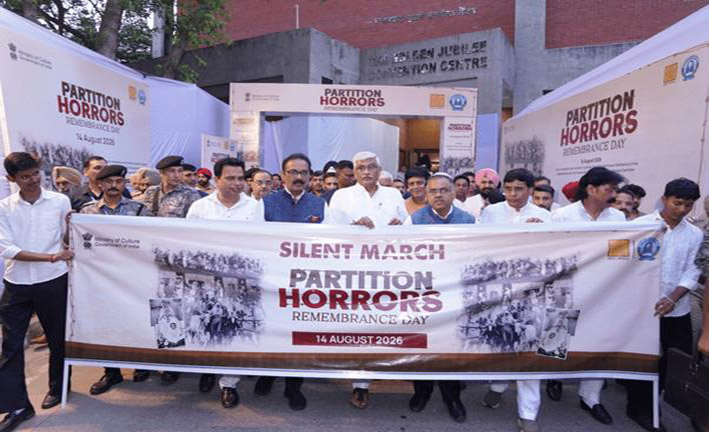
Following the observance, a Silent March was organised in and around the Central Park, Connaught Place as a solemn tribute to those who lost their lives, were displaced from their homes or endured the hardships of Partition. The Ministry also facilitated wider outreach of the Partition Horrors Exhibition, with exhibition material being made available for display at railway stations and other public spaces, enabling travellers and citizens to engage with this important chapter of India’s history. Public service announcements were also proposed to reinforce the message that the tragedies of the past must never be repeated.
Amritsar: Remembering the Punjab Experience
Partition Horrors Remembrance Day was observed at Guru Nanak Dev University (GNDU), Amritsar, yesterday, commemorating the millions of lives affected by the Partition of India and remembering the immense suffering, displacement and sacrifices endured by people during one of the most tragic chapters in the history of the nation.
The programme was graced by Shri Gajendra Singh Shekhawat, Hon’ble Union Minister of Culture and Tourism, as the Chief Guest. The event was also attended by Dr. Vikramjit Singh Sahney, Member of Parliament, Rajya Sabha; Dr. Ashok Kumar Mittal, Member of Parliament, Rajya Sabha; and Shri Tarun Chugh, Member of Parliament, Rajya Sabha.
As part of the observance, a Silent March was organised, with hundreds of students, and local citizens participating. The march served as a solemn tribute to those who lost their lives, homes and livelihoods during the Partition, while underscoring the importance of remembering history and preserving the stories of those who lived through it.
The programme also featured a theatrical presentation of the acclaimed play “Jis Lahore Nai Dekhya O Jamyai Nai”, based on the Partition and its human impact. The play was performed by the Harpal Tiwana Centre for Performing Arts, bringing alive the pain, resilience and shared humanity of people caught amid the upheaval of Partition.
Addressing the gathering, Shri Gajendra Singh Shekhawat emphasised the importance of remembering the horrors of Partition and preserving the memories and experiences of those who suffered during the period. He highlighted that remembrance is not merely about recalling the past, but also about drawing lessons from history and strengthening the values of unity, harmony and peace.
A special exhibition on the Partition was also organised as part of the observance. The exhibition showcased photographs, archival material, documents and narratives reflecting the experiences and hardships of people during Partition. It witnessed enthusiastic participation from a large number of school students and university students, who engaged with the exhibits and gained a deeper understanding of this significant chapter in India’s history.
The participation of hundreds of students and citizens reflected a strong sense of collective remembrance and reaffirmed the importance of engaging the younger generation with the historical experiences of Partition.
The observance at GNDU was a solemn reminder of the human cost of Partition and a tribute to the courage and resilience of those who endured its profound hardships. It also reinforced the message that remembering history is essential to building a more united, peaceful and inclusive future.
Kolkata: Remembering the Bengal Experience
In Kolkata, Partition Horrors Remembrance Day was observed at the Newtown Convention Centre in collaboration with the Government of West Bengal through a two-day programme on 13 and 14 August 2026.
A special exhibition titled “The Partition of India: Memory, Loss and Resilience” was organised in Kolkata on 13 August 2026 in observance of Partition Horrors Remembrance Day. The exhibition was inaugurated by Shri Dipak Barman, Hon’ble Minister of Education, Government of West Bengal, and was visited by more than 1,000 students, providing the younger generation an opportunity to engage directly with archival material and the lived experiences of Partition. The exhibition continued as part of the two-day observance and focused on the distinctive experience of Bengal during Partition, including displacement, migration and rehabilitation, and the profound social, cultural and economic impact on the region.
The 14 August programme was attended by Shri R. N. Ravi, Hon’ble Governor of West Bengal as the Chief Guest in august presence of Shri Swapan Dasgupta, Hon’ble Minister (in-charge), Finance Department, Government of West Bengal; Smt. Purnima Chakraborty, Hon’ble Minister of State, Department of Information and Cultural Affairs & Tourism, Government of West Bengal; Dr. Saumitra Mohan, Secretary, I&CA Department, Government of West Bengal; and Shri K.S. Murali, Director General, NCSM, Ministry of Culture, Government of India, along with senior government officials, distinguished scholars, artists, representatives of civil society, students and other dignitaries.
The programme sought to sensitise the younger generation to the suffering caused by Partition without inheriting hatred and to draw from history a renewed commitment to peace, social harmony, mutual respect and human dignity. Four films on Partition were also screened as part of the programme.
The observance also highlighted the experience of people whose homes, families and communities were disrupted by Partition. The communal violence in Calcutta in 1946 and the subsequent turmoil in Bengal were recalled as part of the wider historical context, while emphasising courage, dialogue and reconciliation during a period of fear and mistrust.
The programme also highlighted the history of Partition as a history of resilience, renewal and nation-building. Refugees who arrived with limited possessions and uncertain futures went on to become teachers, entrepreneurs, professionals, artists, workers, public servants and institution-builders, making significant contributions to the social, economic and cultural life of West Bengal.
The contribution of Dr. Syama Prasad Mookerjee during the critical years preceding Partition and his opposition to the proposal for an undivided Bengal to be included in Pakistan, as well as his advocacy for the creation of a separate province to safeguard the future and interests of Bengali Hindus, was also highlighted in the programme.
The programme concluded with a candlelight march, paying tribute to the victims and survivors of Partition and acknowledging the immense contribution of Partition-affected families to the making of modern West Bengal and India. Partition Horrors Remembrance Day was also observed across all district headquarters in West Bengal.
IGNCA Programmes Across the Country
As part of the nationwide observance of Partition Horrors Remembrance Day 2026, the Indira Gandhi National Centre for the Arts (IGNCA), an autonomous institution under the Ministry of Culture, Government of India, organised a series of academic, cultural and public outreach programmes at its Regional Centres, providing platforms for documenting memories, engaging younger generations and reflecting on the human experiences of Partition.
Jammu & Kashmir: Memories of Survivors and Panel Discussion
IGNCA Regional Centre, Jammu & Kashmir, in collaboration with the District Administration, Rajouri and Baba Ghulam Shah Badshah University, Rajouri, organised “Memories of Survivors: Panel Discussion on Partition Horrors Remembrance Day”, focusing on documenting and preserving the memories, struggles and experiences of people displaced from Pakistan-occupied Jammu & Kashmir during 1947 and 1965. Shri Ramesh Kumar, IAS, Divisional Commissioner, Jammu, was the Chief Guest, while Smt. Devyani Singh Rana, Hon’ble MLA, Nagrota; Prof. Javed Iqbal, Vice-Chancellor, Baba Ghulam Shah Badshah University; and Shri Abhishek Sharma, IAS, Deputy Commissioner, Rajouri, were present. A special highlight was the testimony of 99-year-old Shri Bakshi Yog Raj Chhibber, who shared his first-hand memories of Partition, along with accounts of other displaced families. An exhibition on Partition and a documentary produced by the District Administration, Rajouri, were also presented. Historians, academicians, researchers, media representatives and students from universities and institutions across the Jammu region participated in the programme.
Bengaluru: Student Procession and Documentary Screening
IGNCA Regional Centre, Bengaluru, organised a procession on 14 August 2026 at Vijaya Bharathi Vidyalaya, with the participation of more than 500 students, who carried the Tricolour in remembrance of the victims and hardships of Partition and reaffirmed the values of unity, peace and national solidarity. The observance began with a documentary screening portraying the experiences and memories of those affected by Partition, followed by an insightful talk by Dr. G. B. Harisha on the human dimensions and significance of remembering Partition. The programme was graced by Shri D. Mahendra, Regional Director, IGNCA Regional Centre, Bengaluru, and Prof. P. V. Krishna Bhatta, eminent academician and educationalist.
Ranchi: Padayatra, Exhibition, Special Lecture and Tribal & Regional Language Poets’ Gathering
IGNCA Regional Centre, Ranchi, in collaboration with Ranchi University, organised a special programme comprising a Padayatra, Partition Exhibition, Special Lecture and the Third Tribal and Regional Language Poets’ Gathering on the theme “Displacement”. Prof. Saroj Sharma, Vice-Chancellor, Ranchi University, was the Chief Guest, while Padma Shri Balbir Dutt, senior journalist and author, delivered the special lecture and Swami Bhaveshananda, Secretary, Ramakrishna Mission Ashram, Ranchi, was the Distinguished Guest. The programme brought together historical reflection, personal memories, visual documentation and poetry in tribal and regional languages, exploring displacement, memory, identity, loss and resilience. The exhibition presented visual and documentary material relating to Partition, while poets from several tribal and regional language traditions highlighted the role of indigenous languages in preserving collective memory and lived experiences.
Besides these programmes, Partition Horrors Remembrance Day was also observed across States and Union Territories on 14 August 2026 reaffirming the shared national commitment to remembering the victims and preserving the lessons of Partition.
Remembering so that history is never repeated
Partition resulted in one of the largest episodes of forced migration in modern history, with millions of people displaced across the newly created borders. The tragedy affected communities across Punjab, Bengal, Delhi and several other regions, leaving a lasting imprint on generations of families.
Through its programmes in Delhi, Amritsar and Kolkata, the Ministry of Culture sought to ensure that these memories remained part of India’s collective consciousness. The observances went beyond remembering the tragedy to drawing lessons from it—rejecting hatred and division, strengthening social harmony, and reaffirming the values of unity and human dignity.
The programmes provided citizens, particularly younger generations, an opportunity to engage with the history of Partition and understand the experiences of those who lived through one of the most traumatic chapters in India’s history. The observance of Partition Horrors Remembrance Day 2026 thus served as a solemn tribute to those who suffered, an acknowledgement of the resilience of survivors, and a reminder that the lessons of history must continue to guide future generations.