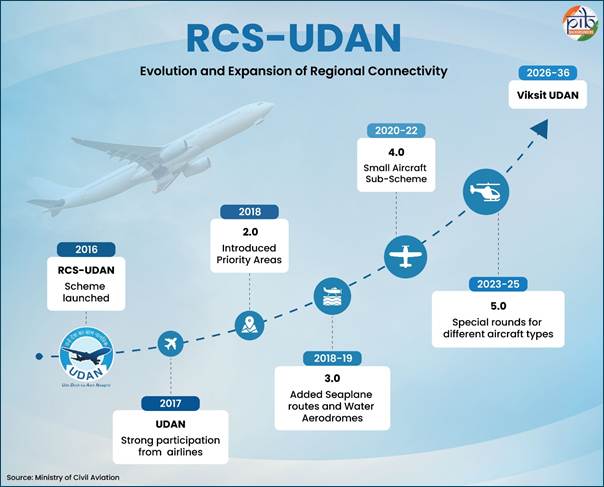

UDAN completes ten years in 2026. Over the past decade, it has expanded India’s regional aviation network, connecting unserved & underserved regions and improving access to air travel. Regional connectivity has supported tourism, medical access, agricultural trade and local employment, with airports such as Tezu, Deoghar and Kishangarh illustrating its impact. The launch of Modified UDAN marks the next phase of the scheme. It focuses on strengthening aviation infrastructure, ensuring operational sustainability and expanding regional air connectivity.
Connecting Regional India
Air connectivity plays an important role in regional development. It facilitates access to markets, supports tourism and expands economic opportunities. However, connecting remote and underserved areas remains important for ensuring wider access to air travel. Recognising this need, the National Civil Aviation Policy 2016 prioritised affordable regional connectivity through financial support and infrastructure development.
In line with this objective, the Regional Connectivity Scheme (RCS), also known as UDAN (Ude Desh ka Aam Nagrik), was launched on 21 October 2016. The scheme anchors its ambition on a simple yet transformative premise: making affordable yet economically viable and profitable air travel on regional routes.
As UDAN completes ten years, it has expanded regional air connectivity and improved access to air travel for citizens by connecting unserved and underserved airports. A recap of the past decade reflects the rapid expansion of India’s civil aviation footprint. India is now the world’s third-largest domestic aviation market, with operational airports increasing from 74 in 2014 to 166 till date. At the heart of this, transformation lies the UDAN scheme.
Building on this progress, the next phase of UDAN was launched on 4 July 2026. The scheme now places greater emphasis on Centre-State/UTs partnerships. It will be complemented by a Challenge Mode Portal for Aerodrome Development dedicated to identifying airstrips and helipads. Together, these measures will further expand regional aviation infrastructure.
The First Decade of UDAN
UDAN entered its operational stage with the inauguration of the first RCS-UDAN flight from Shimla to Delhi in April 2017. Since then, the scheme has expanded regional air connectivity.
Routes Operationalised: The scheme has operationalised 687 regional routes across India.
Aerodromes Operationalised: A total of 95 aerodromes have been operationalised, including 17 heliports and 02 water aerodromes.
Flights Operated: More than 3.68 lakh flights have been operated under the scheme.
Passengers Carried: The scheme has facilitated air travel for 1.72 crore passengers.
The scheme uses market-based selection, airfare caps, concessions, and Viability Gap Funding (VGF) to encourage airline participation. As of 15 October 2026, Rs 5091.23 crore has been disbursed under VGF.
Alongside expansion of civil aviation, sectoral jobs have grown from around 3 million in 2014 to nearly 7.7 million in 2026. Additionally, it has the potential to reach 25 million by 2040.
North-Eastern Region under UDAN
Due to the difficult hilly terrain, the north-eastern states remain under-connected, which makes strengthening air connectivity an important development priority.
Under UDAN, across the North-Eastern States, 90 priority RCS routes have been operationalised.
52 aerodromes, including heliports and water aerodromes, have also been identified in the region, of which 12 have been operationalised.
Transitioning to Next Phase of UDAN
Since its inception, RCS-UDAN has released multiple versions of the scheme. Building on the achievements under it, the next phase of UDAN Scheme was formally launched on 4 July 2026. The scheme will be implemented in ten years, from FY 2026-27 to FY 2035-36, with a total outlay of Rs 28,840 crore. The focus is now on building an ecosystem towards facilitating Made in India Civil aircraft.
The scheme emphasises affordable air travel, sustainable regional aviation operations, aerodrome development through a Challenge Mode framework, and indigenous aircraft manufacturing.
The Modified UDAN Scheme introduces targeted measures to support sustainable growth and long-term viability of regional aviation.
Development of Aerodromes (CAPEX): 100 airports will be developed from existing unserved airstrips, with an outlay of Rs 12,159 crore over eight years. This amounts to a proposed allocation of Rs 100 crore per airport.
Operation and Maintenance (O&M) of Aerodromes: Three years of O&M support will be provided for approximately 441 aerodromes, with an estimated outlay of Rs 2,577 crore. The financial support is capped at Rs 3.06 crore per airport per year and Rs 0.90 crore per heliport or water aerodrome per year.
Development of Modern Helipads: 200 modern helipads to be developed at an estimated cost of Rs 15 crore each. The total projected outlay is Rs 3,661 crore over eight years.
Viability Gap Funding for Airlines: Rs 10,043 crore allocated over ten years to support airlines operating regional routes. Funding is available for up to five years, with tapered support from the third year and route exclusivity limited to three years.
Atmanirbhar Bharat and Indigenous Aviation Capacity: An allocation of Rs 400 crore is proposed for two HAL Dhruv helicopters for Pawan Hans and two HAL Dornier aircraft for Alliance Air. The initiative supports indigenous aviation under Atmanirbhar Bharat and aims to strengthen connectivity in remote areas and challenging terrain.
The Next Phase Takes Shape
In the next phase of UDAN, the scheme will have a three-pronged approach focusing on strengthening Centre-State/UT partnerships, creating aviation infrastructure and expanding regional air connectivity.
Centre-State/UT Coordination: A total of 21 MoUs were signed between the Government, participating States and Union Territories, and the Airports Authority of India (AAI). These establish a framework for coordinated identification, development and operationalisation of aviation assets. The framework will align with regional connectivity requirements and State/UT priorities.
Challenge Mode Portal for Aerodrome Development: The dedicated portal enables State Governments and UT Administrations to nominate airstrips and helipads for development under the next phase of UDAN. This allows States and UTs to identify locations with potential for aviation connectivity. This will facilitate the creation and upgradation of aviation infrastructure based on local requirements.
Regional Changes under UDAN
The operationalisation of regional airports under UDAN has driven socio-economic transformation across regional hubs, boosting local trade, medical access, tourism, and employment.