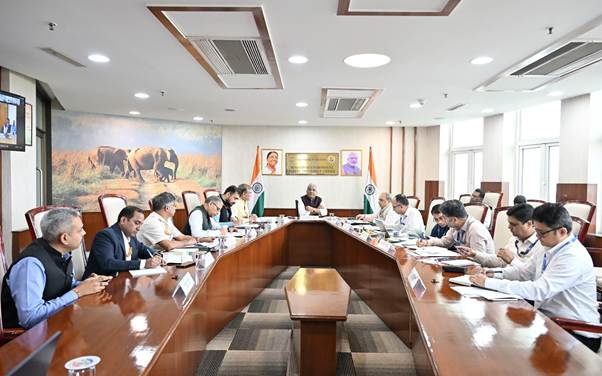

Union Minister for Environment, Forest and Climate Change, Shri Bhupender Yadav, today chaired a review meeting to assess measures undertaken by Delhi, Haryana, Uttar Pradesh and Rajasthan for mitigation of air pollution in Delhi-NCR. The Minister has held more than 30 review meetings with NCR State Governments, Municipal Bodies over the past one year to strengthen air pollution preparedness and ensure effective implementation of control measures already identified in the detailed action plans prepared under Shri Yadav’s guidance.
State Environment Ministers, Sardar Manjinder Singh Sirsa (NCT Delhi); Shri Rao Narbir Singh (Haryana); and, Shri Arun Kumar Saxena (Uttar Pradesh) joined the meeting virtually. Shri Narendra Bhooshan, Secretary (MoEFCC) and Dr. Amandeep Garg, AS (MoEFCC) and Chairman (CPCB) joined the meeting virtually from Antalya, Türkiye. Shri Tarun Pithode, Member Secretary, CAQM, presented the progress made by NCR States, while Shri Rajesh Verma, Chairperson, CAQM, gave an overview on the on-ground implementation of the action plans of different States and measures yet to be taken on different fronts.
With winter pollution intensifying, the Union Minister directed all agencies to move beyond planning and ensure rigorous, time-bound and coordinated enforcement on the ground. Emphasising that air pollution does not recognise State boundaries, he called for coordinated implementation of matching pollution control measures across NCR. Shri Yadav also stressed real-time monitoring through Integrated Command and Control Centres (ICCCs) and direct accountability of field officers for violations. State Governments were directed to nominate Secretary level officials for 7 cities in Haryana, 4 cities in UP and 4 cities in Rajasthan for making them responsible for implementation of pollution control measures through field visits and report to CAQM on weekly basis. CAQM was requested to issue notices to non-performing officers.
Shri Yadav further emphasized that all concerned States must install ANPR cameras, failing which CAQM would initiate criminal prosecution against delinquent Transport Department officials after 30.11.2026. The CPCB was directed to immediately seal the identified 191 non-conforming polluting industries, which despite repeated directions had not even placed orders for installation of Air Pollution Control Devices (APCDs). To ensure immediate corrective action, regular review of respective hotspot action plans of individual States would be undertaken by the Secretary (MoEFCC), Secretary (MoHUA), Chairman (CPCB), and Chairperson, CAQM, along with other senior officers. The Union Environment Minister, along with the concerned State Ministers, would also undertake regular field inspections, Shri Yadav stated.
Issue-wise detailed directions on various action points are given as follows:
Strict Enforcement of GRAP and Winter Action Plans: The Minister directed all agencies to ensure strict implementation of GRAP and called upon NCR States to adopt Delhi’s hotspot-focused winter action plan, covering traffic management, work-from-home measures, construction restrictions and prevention of open burning. In accordance with CAQM’s order dated 30.10.2026, dust-generating Construction and Demolition (C&D) activities have been restricted across NCR from 5th to 20th November 2026.
Road Dust and Traffic Management: Reviewing road dust management, Shri Yadav noted that only 3,221 km of the targeted 5,480 km of roads had been redeveloped. He directed road-owning agencies to prioritise pothole repairs, damaged footpaths, central verges and end-to-end paving as per CAQM framework, along with AI-based videographic surveys. Mechanical road sweeping machines must be fully utilised and operated in double shifts, with digital tracking and AI-based monitoring through ICCCs. States were also directed to intensify deep-cleaning drives and ensure removal of silt, C&D waste and municipal waste. For traffic decongestion, the Union Minister directed immediate action at the 233 identified congestion points across NCR and fresh assessments by respective States. MCD was asked to complete installation of Multi-Lane Free Flow systems at 154 Delhi border entry points by 31.12.2026.
Vehicular and Industrial Pollution: On vehicular pollution, Shri Yadav called for expediting the PARIVARTAN Scheme for replacing pre-BS-VI trucks and buses with BS-VI, CNG and electric vehicles by 2028, particularly accelerating beneficiary registrations in Uttar Pradesh, Rajasthan and Haryana by organizing PARIVARTAN Melas at State level immediately. The States were also asked to expedite installation of ANPR-based monitoring systems at fuel stations, integrated with VAHAN and PUCC databases, for intensified action against old and polluting vehicles.
On Industrial Emissions, the Minister noted that 2,298 of the 2,345 targeted industries (98%) had been connected to OCEMS, while the remaining 47 units had been closed or sealed. He called for strict enforcement of the 50 mg/Nm³ particulate matter emission norm, with non-compliant industries facing closure, electricity disconnection and sealing wherever required. He noted that under the CPCB’s winter enforcement SOP, effective from 01.10.2026 to 28.02.2027, OCEMS-based alerts and monitoring cells have been operationalised across NCR. State Pollution Control Boards were asked to facilitate MSMEs in accessing financial assistance under the Swachh Pawan Neel Gagan, Swasth NCR (SPNG-NCR) Scheme for installation of APCDs and take action against the non-compliant polluting industries in non-conforming areas.
Waste Management and Prevention of Open Burning: The Union Minister stressed on the States to bridge the 6,747 TPD gap in municipal solid waste processing capacity, strictly prevent open dumping and burning, and expedite remediation of legacy waste at Okhla, Ghazipur, Bhalswa and Bandhwari. He also called for physical inspection of over 3,000 active C&D sites, timely lifting of waste from secondary collection points, ensuring functional recycling plants and digital tracking of waste from collection to processing through ICCCs. Municipal bodies, RWAs and private establishments were asked to provide non-polluting heating alternatives for security and sanitation staff, with ward-level officers and sanitation inspectors made responsible for surveillance and prevention of open burning.
Hotspot Management: Highlighting the need for targeted interventions, Shri Yadav emphasized that all NCR States must identify pollution hotspots in major cities and prepare focused Hotspot Action Plans, particularly covering markets, schools, hospitals, railway stations and bus terminals.
Technology-driven Monitoring and Public Participation: Emphasising technology-led enforcement, the Minister highlighted Delhi’s ICCC, launched on 05.10.2026, and CAQM’s PAVAN (Platform for Air Quality Vigilance and Analytics for NCR), which integrates air quality, emissions, meteorological, satellite and compliance data on a single platform. Shri Yadav stressed that real-time inputs from sensors, cameras and satellites must be used alongside physical inspections to identify violations and ensure swift enforcement. Shri Yadav also called upon all NCR States and agencies to ensure time-bound completion of pending actions and undertake extensive Information, Education and Communication (IEC) campaigns involving citizens, RWAs, transport associations and the construction industry.
Concluding the review, the Union Minister emphasised that coordinated efforts, field-level accountability and visible action on the ground are essential to effectively address the challenge of air pollution in Delhi-NCR.