
India’s Container Traffic: A Growing Demand for Port Capacity
India’s maritime network is a vital gateway to global markets. Nearly 95 per cent of the country’s trade by volume and around 70 per cent by value moves through maritime routes. As trade grows, ports must expand their capacity to handle larger cargo volumes.
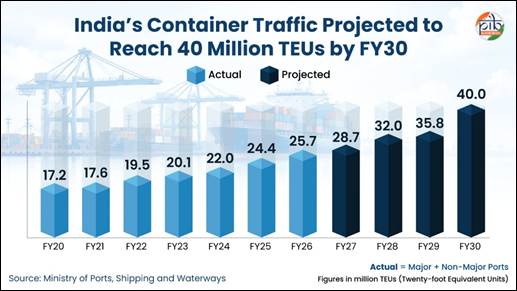
Container traffic across Indian ports grew at a compound annual growth rate (CAGR) of 6.9 per cent between FY 2019–20 and FY 2025–26, reaching 25.7 million Twenty-foot Equivalent Units (TEUs). A TEU is a standard unit for measuring container capacity, equivalent to one 20-foot shipping container. Container traffic is projected to reach about 40 million TEUs by FY 2030.
Between FY 2014–15 and FY 2025–26, the cargo-handling capacity of India’s major ports increased from 873 million tonnes per annum to 1,728 million tonnes per annum. Addressing this growing demand, the Government approved the development of a second container terminal at Tamil Nadu’s Kamarajar Port Limited on 25 November 2026. The project will add 2 million TEUs of annual capacity upon completion.
Kamarajar Port: Building on Existing Infrastructure
Located about 24 km north of Chennai, Kamarajar Port is an important maritime gateway for Tamil Nadu’s industrial hinterland. Formerly known as Ennore Port Limited, Kamarajar Port Limited (KPL) is one of India’s 12 major ports. It handles diverse cargo, including coal, petroleum products, LNG, LPG, containers, automobiles and general cargo.