

“A Disease-Free Tomorrow for Indian Livestock”
The National Animal Disease Control Programme (NADCP) launched in 2019, represents one of India’s largest livestock health initiatives aimed at controlling and eradicating Foot and Mouth Disease (FMD) and Brucellosis through nationwide vaccination and surveillance. The programme has administered 147.16 crore FMD vaccine doses, benefiting 8.04 crore farmers. Strengthened immunity has contributed to a significant reduction in disease incidence, with reported FMD outbreaks declining from 132 in 2019 to 40 by 2025 and Brucellosis outbreaks falling from 22 in 2019 to 15 in 2025. The NSP antibody prevalence has declined from 20.8% in 2019 to 8.1% in 2025, indicating reduced circulation of FMD through evidence-based surveillance and sustained disease control efforts. There has been no outbreak of FMD caused by Serotype Asia-1 for the last three years in the country. The programme is supported by strengthened veterinary infrastructure, digital livestock databases, research institutions, and One Health initiatives. More than 39.00 crore livestock have been registered on the Bharat Pashudhan Portal, and 4,019 Mobile Veterinary Units have provided doorstep services to 136 lakh farmers and treated 276 lakh animals. By integrating disease control, digital monitoring, and pandemic preparedness, the NADCP is contributing to a more disease-secure livestock sector in India.
Building a Disease-Free Livestock Sector
Livestock has long been a significant source of livelihood support in Indian agriculture and allied sectors in rural areas. As per the 20th Livestock Census 2019, the total livestock population is 535.78 million, including 302.79 million bovines. The large livestock population underscores the importance of animal health and well-being. However, infectious diseases such as Foot and Mouth Disease (FMD) and Brucellosis have historically caused substantial economic losses due to reduced milk yield, reproductive failure, and trade restrictions.
FMD is a highly contagious viral disease that affects cloven-hoofed animals, including cattle, buffalo, sheep, goats, and pigs. The disease reduces milk production, slows growth, affects reproductive performance, and lowers the working capacity of draft animals. It also limits access to international markets. Effective control of FMD depends on regular mass vaccination of all susceptible livestock.
Brucellosis is a reproductive disease of cattle and buffaloes caused by bacteria Brucella abortus. It primarily affects the reproductive organs of animals, disrupting their normal reproductive function. It disrupts fertility and lactation, which, in turn, affects milk and meat production. As there is no curative treatment for bovines, vaccination is the most effective and sustainable control measure.
To strengthen animal health management, the Government launched the National Animal Disease Control Programme (NADCP) in September 2019 to control and eradicate FMD and Brucellosis through nationwide vaccination. The programme targets 100 % vaccination of all livestock against FMD twice a year and one time vaccination against Brucellosis in 4-8 months old female bovine calves in their lifetime
Reducing Livestock Disease Burden through Integrated Action under NADCP
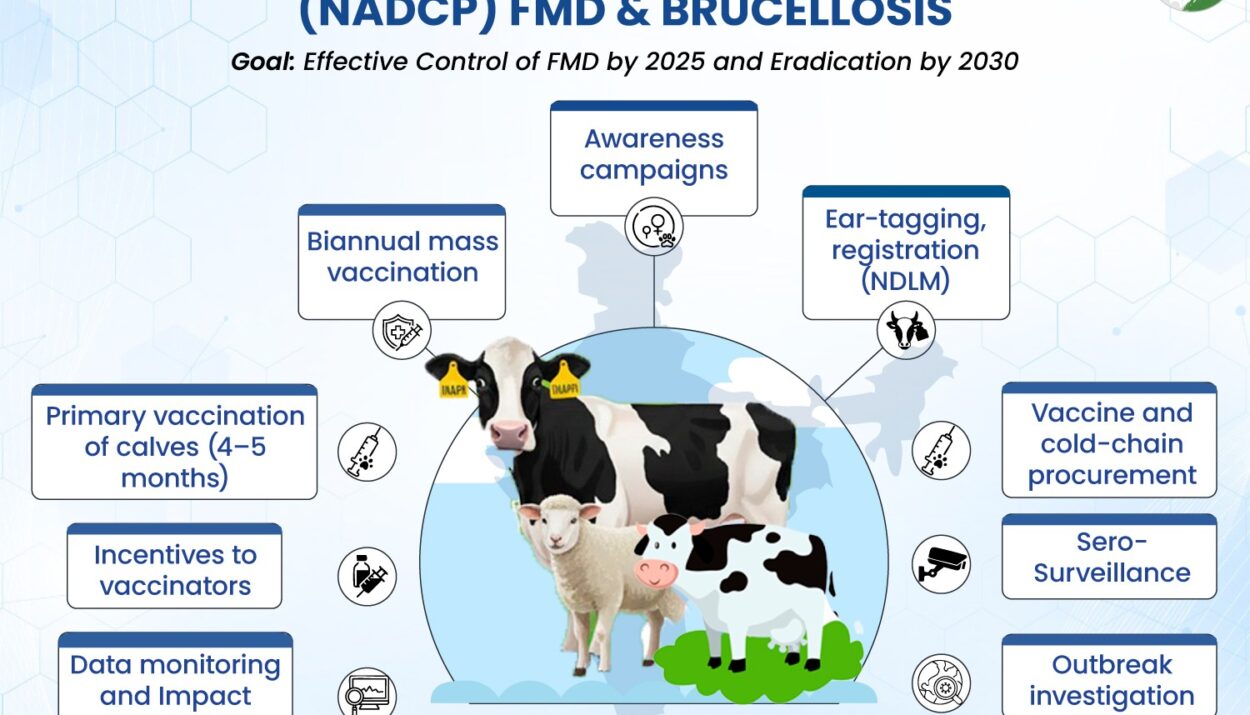
The programme aims to control Foot and Mouth Disease (FMD) through biannual mass vaccination of all eligible livestock and Brucellosis through a one-time vaccination of female bovine calves aged 4–8 months during their lifetime. It also supports disease surveillance and the procurement of cold-chain logistics.
Mass FMD vaccination of all susceptible bovines and small ruminants every six months.
Public awareness campaigns and orientation of officials for effective programme implementation.
Ear-tagging, registration, and uploading of animal data on the Bharat Pashudhan Portal (NDLM).
Sero-surveillance and monitoring through pre- and post-vaccination sample testing.
Procurement of vaccines and cold-chain equipment to ensure quality delivery.
Outbreak investigation, virus isolation and typing, and regulation of animal movement through quarantine and check-posts.
Continuous data generation, monitoring, and impact evaluation.
Remuneration to vaccinators, with a minimum of ₹3 per vaccination dose.
Sero-surveillance & Sero-monitoring
Sero-surveillance involves population-level assessment of antibody prevalence to estimate disease exposure and immunity, sero-monitoring focuses on longitudinal tracking of antibody levels to understand immunity.
Financial Commitment to Livestock Health and Disease Control
Building on the success of NADCP, the Government has integrated disease control, veterinary services and animal healthcare under the Livestock Health and Disease Control Programme (LHDCP), enabling a more comprehensive and sustainable animal health framework. Under the revised LHDCP, NADCP, the Livestock Health and Disease Control (LH&DC) component, and the Pashu Aushadhi initiative have been subsumed into a single umbrella scheme to facilitate integrated implementation and effective management of livestock health interventions. The total budget outlay for the Livestock Health and Disease Control Programme (LHDCP) for the financial year 2026–27 is ₹2,010 crore.
National Efforts and Outcomes in Controlling FMD and Brucellosis
The scale of interventions undertaken and the measurable outcomes achieved under the National Animal Disease Control Programme (NADCP) through sustained vaccination, surveillance, and monitoring efforts across the country are as follows:
Foot and Mouth Disease (FMD)
Cumulative FMD vaccination under the NADCP reached 147.16 crore FMD vaccine doses, benefiting 8.04 crore farmers.
Reducing FMD Risk in Migratory Animal Population
Since 2024, FMD vaccination has been extended to pastoral sheep and goats. The programme covers migratory populations in Haryana, Himachal Pradesh, Uttarakhand, and the Union Territories of Jammu & Kashmir and Ladakh to prevent the spread of disease along migratory routes.
Improved Immunity and Decline in Disease Outbreaks
FMD type O: The most common and widespread serotype in India and many parts of the world. It causes frequent outbreaks.
FMD type A: A highly variable serotype, meaning it changes easily and needs well-matched vaccines.
FMD type Asia1-A serotype mainly found in South Asia, including India, but less widespread than type O
Sero-monitoring conducted to assess post-vaccination antibody response indicates that the average protective immunity against Foot and Mouth Disease (FMD) virus serotypes O, A, and Asia1 stands at 78.1%, 71.7%, and 77.6%, respectively. These levels indicate strong herd immunity. The improved immunity has led to a sharp decline in disease incidence. The reported FMD outbreaks fell from 132 in 2019 to just 40 cases by 2025. This reflects the effectiveness of nationwide vaccination coverage.
Brucellosis
Under the NADCP, female bovine calves aged 4-8 months receive a one-time Brucellosis vaccination in their lifetime.
Improved Immunity and Decline in Disease Outbreaks
In 2025, post-vaccination monitoring shows seroconversion rates (percentage of vaccinated animals that develop antibodies) of 75.63 % in cattle calves and 67.17 % in buffalo calves. The findings indicate effective immunity, which has contributed to a sharp decline in Brucellosis cases. The incidence of reported outbreaks reduced from 22 in 2019 to 15 in 2025, demonstrating the positive impact of the programme’s interventions.
Improvement in Bovine Productivity and Milk Production
Indigenous and Non-Descript Cattle Productivity: The productivity of indigenous (local) and non-descript (mixed-breed) cattle has increased from 927 kilograms per animal per year in 2014-15 to 1,343.2 kilograms in 2024-25, representing a rise of 44.89%.
Buffalo Productivity: Similarly, the productivity in buffalo has improved from 1,880 kilograms to 2,365.2 kilograms per animal per year during the same period, representing a 25.80% increase.
Bovine Productivity: Consequently, the average bovine productivity in India has risen from 1,640 kilograms per animal per year in 2014-15 to 2,250 kilograms in 2024-25. This represents a 36.63 % increase and the highest productivity gain recorded by any country globally.
Milk Production Growth: India’s milk production has increased from 146.31 million tonnes in 2014-15 to 247.87 million tonnes in 2024-25. This represents a 69.4 % increase over the past decade. The scheme aims to enhance bovine productivity further and achieve an average milk production of 3,000 kilograms per animal per year by 2030.
Institutional and Infrastructure Support Systems for Disease Control
Research and Surveillance Support
Financial support is provided to key ICAR institutions to strengthen FMD and Brucellosis control. The support covers vaccine research, quality testing, surveillance, sero-surveillance, disease modelling, and state-wise sampling. These measures ensure the effective and science-based implementation of the programme.
Centralized Vaccine Procurement with Private Sector Engagement
States and UTs receive assistance for procuring vaccination accessories and strengthening cold-chain infrastructure. Through the Animal Husbandry Infrastructure Development Fund, financial assistance is provided to individual entrepreneurs, private companies, and other eligible entities. This supports the establishment of veterinary vaccine and drug manufacturing facilities.
Veterinary Infrastructure and Service Delivery
Veterinary facilities and Mobile Veterinary Units (MVUs) are being strengthened to ensure last-mile animal healthcare. A total of 4,019 MVUs are operational across 29 States and UTs. They provide doorstep veterinary services through the toll-free number 1962. So far, the initiative has benefited 136 lakh farmers and treated 276 lakh animals.
Digital Integration through Bharat Pashudhan Portal
The Bharat Pashudhan Portal integrates livestock registration, FMD, and Brucellosis vaccination data, with each animal assigned a unique 12-digit Tag ID. By July 2026, over 39.00 crore livestock had been registered on the portal. This has enabled real-time monitoring, improved traceability, and a more transparent, data-driven implementation of livestock development programmes.
AI-enabled analytics, vaccination traceability, real-time dashboards and evidence-based planning can further strengthen disease surveillance and resource allocation in future.
Awareness and Farmer Engagement
Farmer outreach is strengthened through Multi-Purpose Artificial Insemination Technicians in Rural India (MAITRIs), who provide doorstep veterinary services. So far, 39,810 technicians have been trained with financial support.