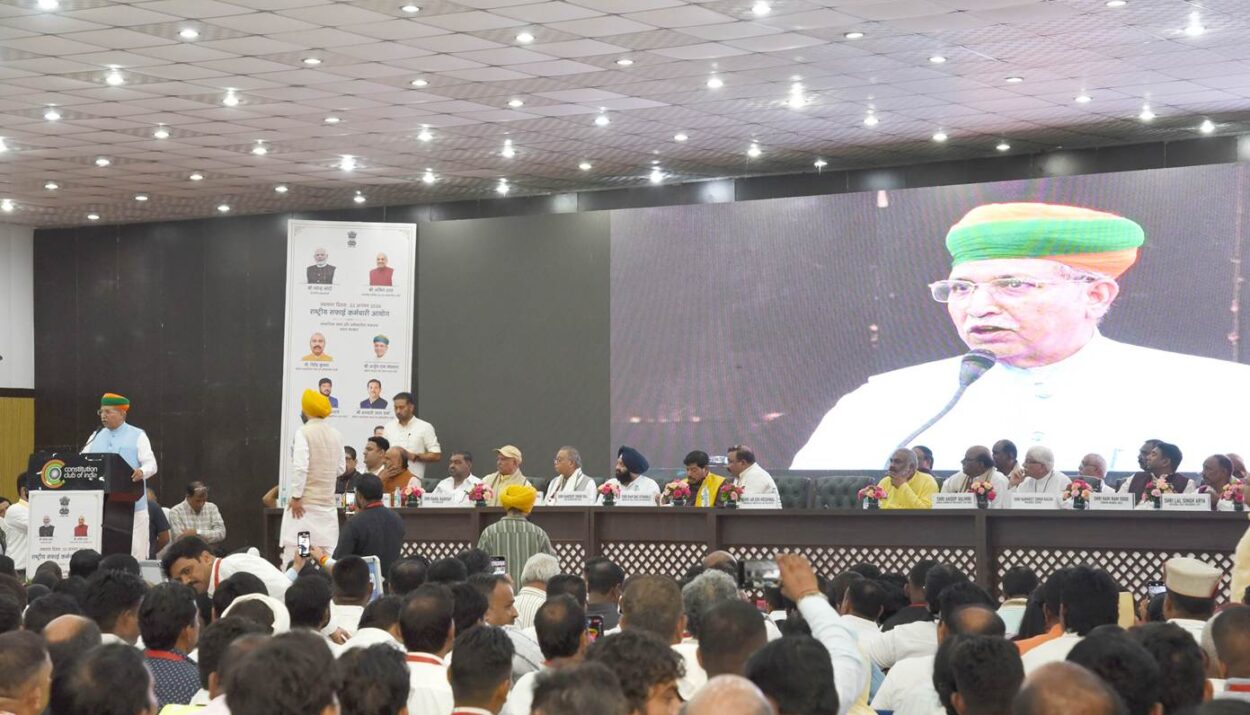

The National Commission for Safai Karamcharis (NCSK) celebrated its 33rd Foundation Day at the Constitution Club of India in the National Capital here today. The event was first of its kind ever celebrated to honour the Safai Karamcharis since setting up of the Commission in 1994.
The day long programme was attended by over 900 Safai Karamcharis, large number of representatives of Central, State/UT governments, Urban Local Bodies (ULBs), Public Sector Organizations, civil society organizations and other stakeholders working for the welfare, dignity and safety of Safai Karamcharis.
Union Minister of State of Law & Justice (I/C) Ministry of Law & Justice & MoS Parliamentary Affairs Shri Arjun Ram Meghwal, Minister of State of Social Justice And Empowerment Shri Ramdas Athawale, Shri Anoop Valmiki, Member of Parliament, Lok Sabha,
Vice Chairperson NCSK Shri Hardeep Singh Gill, Member NCSK Shri Karam Singh Karma, NCSK Secretary Shri Rahul Kashyap besides Senior Officials of the Ministries and the Commission graced the occasion.
The Programme focussed on the dignity and welfare of Safai Karamcharis, eliminiation of hazardous manual scavenging/ cleaning, promotion of mechanized sanitation, rehabilitation and social security and implementation of welfare initiatives under the PM Narendra Modi led NDA government.
Addressing the large gathering, Shri Arjun Ram Meghwal said the Foundation Day was not merely a celebration of an institution’s journey, it was also an occasion to honour the contribution of millions of sanitation workers who keep the country’s cities, villages, institutions and public spaces clean and safe every day.
He underlined that the Constitution is founded on equality, dignity and social justice, and sanitation workers are entitled to the same constitutional dignity and equality of opportunity as every other citizen. He said the nation’s resolve must be that no person should have to undertake work for a livelihood that endangers life, health or dignity.
Referring to the Prohibition of Employment as Manual Scavengers and their Rehabilitation Act, 2013, Shri Meghwal said the legislation embodies a social and constitutional responsibility. He stressed that the true success of a law lies not merely in its enactment but in its effective implementation.
He emphasised the complete elimination of hazardous manual cleaning and maximum use of machines for cleaning sewers and septic tanks. He said that the sanitation workers must receive training, safety equipment and social-security support, while accountability must be ensured in every accident or death. Assistance, compensation and rehabilitation must reach affected families in a time-bound manner.
Shri Meghwal said as India advances towards becoming a developed nation, its sanitation system must likewise become modern, scientific, technology-driven and fully aligned with human dignity and no human life should be put at risk for work that a machine can perform safely.
Highlighting the importance of the National Commission for Safai Karamcharis, Shri Meghwal said the Commission performs a vital role by bringing the concerns of sanitation workers to the forefront, attending to grievances, assessing conditions across States and local bodies, and recommending necessary corrective measures to the Government.
The Minister added that protecting the rights of sanitation workers is not the responsibility of the Government or the Commission alone. State Governments, urban local bodies, employing institutions and society as a whole must participate equally. The country must build a system in which a sanitation worker is seen not merely as a service provider but as an equal partner in nation-building.
Shri Meghwal reiterated that the national goal must be clear: zero hazardous manual entry; zero sewer and septic-tank deaths; complete mechanisation; and a dignified and safe life for every sanitation worker.
Congratulating the National Commission for Safai Karamcharis on its Foundation Day, Shri Meghwal expressed the expectation that the Commission would continue to work with the Government, States and local bodies and play an even more effective role in protecting the rights and honour of sanitation workers.
He called upon all stakeholders to take a collective pledge that no sanitation worker in India should lose their life while performing duty and every sanitation worker should return home safely and with dignity each day.
Addressing the programme, Shri Ramdas Athawale acknowledged the invaluable contribution of Safai Karamcharis in safeguarding public health, maintaining environmental cleanliness and promoting the overall well-being of the nation. He observed that every clean street, efficiently functioning sewer system and hygienic public place reflects the dedicated efforts of thousands of sanitation workers who continue to perform essential services under challenging conditions.
The Minister emphasised that every Safai Karamchari is entitled to dignity, safety, equal opportunity and social justice. He added that the unsafe practices must be replaced by technology, hazardous entry into confined spaces must give way to mechanisation, and there can be no compromise on the safety of sanitation workers.
Highlighting the Government’s commitment to improving occupational safety, Shri Athawale referred to various initiatives aimed at promoting mechanised sanitation systems, strengthening rehabilitation measures and expanding access to social security benefits for sanitation workers. He said the ultimate objective must be to achieve zero deaths and zero hazardous manual entry.
Referring to the National Action for Mechanised Sanitation Ecosystem (NAMASTE) Scheme, Shri Athawale described it as a transformative initiative for creating a safe, mechanised and dignified sanitation ecosystem. He said that the scheme seeks to ensure the safety, health and socio-economic empowerment of sanitation workers through their identification and profiling, provision of safety equipment, training, healthcare coverage, skill development and access to sustainable livelihood opportunities.
shri Athawale also commended the National Commission for Safai Karamcharis for its important role in monitoring implementation, examining grievances, undertaking field visits and advising Governments on measures required to improve the welfare of sanitation workers.
Congratulating the National Commission for Safai Karamcharis on its Foundation Day, Shri Athawale appreciated its continued efforts to safeguard the rights and welfare of sanitation workers. He assured continued support towards achieving the shared objective of creating a safe, dignified and inclusive sanitation ecosystem.
Shri Athawale called upon all stakeholders to work together to ensure that every Safai Karamchari returns home safely from work every day.
Addressing the gathering, Shri Hardeep Singh Gill, Hon’ble Vice-Chairperson, National Commission for Safai Karamcharis, reaffirmed the Commission’s unwavering commitment to ensuring dignity, safety, equal opportunities and social justice for Safai Karamcharis across the country.
Welcoming the Chief Guest, dignitaries, senior officials, representatives of State Governments and Urban Local Bodies, members of the media and Safai Karamcharis, Shri Gill said that the Foundation Day was not merely an occasion to commemorate the establishment of the Commission, but also an opportunity to express the nation’s gratitude to millions of Safai Karamcharis whose tireless efforts keep India’s cities, towns and villages clean, safe and healthy. He described the contribution of Safai Karamcharis as a cornerstone of nation-building and emphasised that their welfare must remain at the centre of India’s development journey.
Shri Gill stated that the Commission’s mandate extends beyond resolving grievances adding its larger objective is to bring lasting and positive improvements to the lives of Safai Karamcharis by protecting their rights and ensuring that they can live with dignity and work in a safe environment.
Highlighting the Commission’s initiatives, the NCSK Vice Chairperson said that it has undertaken visits to various States, interacted directly with Safai Karamcharis, examined their concerns and held review meetings with State Governments and local authorities. The Commission has also submitted recommendations on several important issues with the objective of bringing systemic and sustainable reforms.
Referring to India’s vision of “Viksit Bharat 2047”, Shri Gill called for concerted action to ensure safe working conditions, extensive use of modern machinery and technology, proper training, adequate protective equipment and the highest priority to accident prevention. He also emphasised that Safai Karamcharis and their families must have access to education, healthcare, social security and dignified livelihood opportunities.
Shri Gill asserted that the vision of a Swachh Bharat could be fully realised only when Safai Karamcharis are safe, respected and empowered.
Shri Gill expressed gratitude to the Chief Guest & Guest of Honour for providing valuable guidance and enhancing the significance of the occasion. He also congratulated the Members and Secretary of the Commission, its officers and employees, and all those associated with organising the Foundation Day Celebration.
On the occasion, Shri Hardeep Singh Gill also presented Congratulatory Message of Union Home Minister Shri Amit Shah, addressed to Safai Katramcharis on the occasion of completion of 32 years of the National Commission for Safai Karamcharis.
Shri Karam Singh Karma, Hon’ble Member, National Commission for Safai Karamcharis, paid tribute to sanitation workers across the country for their invaluable contribution towards keeping India’s cities, towns and villages clean, healthy and liveable.
Shri Karma stated that the Foundation Day was not merely an occasion to commemorate the establishment of the Commission but recognising their contribution and ensuring their dignity was a collective moral responsibility.
Talking about his interactions with sanitation workers, their families, local administrations and other stakeholders across different States, Shri Karma observed that every sanitation worker was not merely a worker, but also the hope of a family, a source of strength for society and an important partner in the nation’s progress.
Shri Karma stated that the extensive use of modern machinery and technology in sewer and septic tank cleaning was the most effective way to prevent accidents and protect human lives. He called upon all stakeholders to ensure that no sanitation worker was ever required to risk his or her life while performing sanitation-related duties. Providing appropriate safety equipment, proper training and secure operating procedures to every worker must remain a shared responsibility, he added.
Shri Karma urged all stakeholders to renew their commitment towards the dignity, safety, social justice and welfare of sanitation workers and work collectively to build an India where every sanitation worker could discharge his or her duties with pride, dignity and complete safety.
Earlier, Shri Rahul Kashyap, Secretary, National Commission for Safai Karamcharis, said that the Foundation Day offered an important occasion to express gratitude to every Safai Karamchari in the country and highlighted that the lives of sanitation workers have been marked by courage, dedication and an enduring spirit of service to society and the nation.
The Secretary observed that many Safai Karamcharis continue to work under difficult conditions and may face challenges such as mistreatment, lack of awareness about welfare schemes, delayed payment of wages and inadequate safety arrangements. The Commission remains committed to addressing these concerns and improving their working and living conditions.
Shri Kashyap said over the years, the Commission has served as an important bridge between the Central Government, State Governments, local bodies and the Safai Karamchari community and continuously worked to safeguard their rights, resolve their grievances and promote their social and economic empowerment.
Referring to cases of deaths during sewer and septic tank cleaning, Shri Kashyap said that every such death represents an irreparable loss to the affected family. He informed that in accordance with the directions of the Hon’ble Supreme Court and through sustained coordination with State Governments and local bodies, the prescribed compensation has been provided to the families concerned in 1,223 out of 1,377 reported cases across the country. The Commission continues to monitor the remaining cases to ensure the payment of compensation and other assistance due to the affected families.
Shri Kashyap said the Commission receives more than 1,200 complaints annually and takes up these matters with the government departments, local bodies and other institutions concerned for appropriate action and resolution. He said the Commission has also been working towards the effective implementation of the Prohibition of Employment as Manual Scavengers and their Rehabilitation Act, 2013, and the Rules framed thereunder.
The Secretary stated that the accountability in cases of sewer and septic tank deaths remains another major area of focus. He said out of the 1,377 reported cases, FIRs have been registered in 750 cases. The Commission is pursuing the remaining cases with the respective State Governments and local bodies so that FIRs are registered wherever required under the law and appropriate legal action is taken against those responsible, he added.
On the occasion, Shri Ram Arjun Meghwal released NCSK Missed-Call Facility Number for all the stakeholders so that the Commission could follow up the callers to register their grievances, issues and representations to be taken up for resolving the same in a time bound manner.
Shri Arjun Meghwal, Shri Ramdas Athawale, Shri Hardeep Singh Gill, Shri Karam Singh Karma, Secretary Rahul Kashyap and other dignitaries released the NCSK Annual Calendar-2026, on the occasion.
The Commission also distributed Appreciation Certificates among Outstanding Safai Karamcharis and felicitated 250 Safai Karamcharis of Municipal Council of Delhi.
Pertinently, the mandate of the National Commission for Safai Karamcharis is to recommend to the Central Government specific programmes of action towards elimination of inequalities in status, facilities and opportunities for Safai Karamcharis, study and evaluate the implementation of the programmes and schemes relating to the social and economic rehabilitation of Safai Karamcharis and scavengers in particular and investigate specific grievances and take suo-motu notice of matters relating to non-implementation of programmes or schemes in respect of any group of Safai Karamcharis, decisions, guidelines or instructions, aimed at mitigating the hardships of Safai Karamcharis, measures for the social and economic upliftment of Safai Karamcharis, the provisions of any law in its application to Safai Karamcharis and take up such matters with the concerned authorities or with the Central or State Governments.
In addition, the Commission has the mandate to study and monitor the working conditions, including those relating to health, safety and wages of Safai Karamcharis working under various kinds of employers including Government, Municipalities and Panchayats, and to make recommendations in this regard, to make reports to the Central or State Governments on any matter concerning Safai Karamcharis, taking into account any difficulties or disabilities being encountered by Safai Karamcharis.
However, with the enactment of “The Prohibition of Employment as Manual Scavengers and Their Rehabilitation Act, 2013”, the mandate and scope of the Commission has also been enlarged. As per Section 31(1) of the said Act, the Commission has jurisdiction to monitor the implementation of the Act, to enquire into complaints regarding contravention of the provisions of the Act, and to convey its findings to the concerned authorities with recommendations requiring further action, to advise the Central and the State Governments for effective implementation of the provisions of the Act and to take suo motu notice of matter relating to non-implementation of the Act.
The Commission also reviews various problems of Safai Karamcharis, status of payment of compensation to the legal heirs of sewer death victims. Based on its findings, the Commission gives its recommendations for rehabilitation and liberation of Safai Karamcharis from the scourge of manual scavenging to the Ministry of Social Justice and Empowerment from time to time as well as in its Annual Reports.