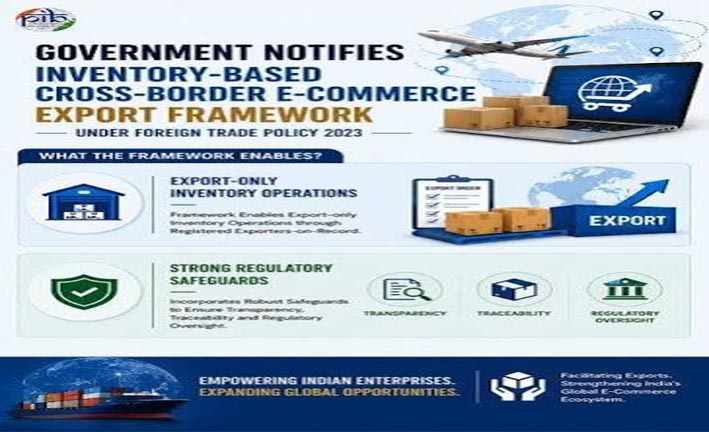

Framework Enables Export-only Inventory Operations through Registered Exporters-on-Record
Framework Incorporates Robust Safeguards to Ensure Transparency, Traceability and Regulatory Oversight
The Government of India has operationalised the Inventory-based Cross-border E-Commerce Export Framework under the Foreign Trade Policy (FTP), 2023 through Notification No. 27/2026-27 dated August 5, 2026 and the corresponding Public Notice No. 25/2026-27 dated August 5, 2026. The framework provides a comprehensive policy and procedural architecture for facilitating inventory-based cross-border e-commerce exports of goods manufactured or produced in India.
The rapid growth of cross-border e-commerce presents a significant opportunity for Indian manufacturers, artisans and MSMEs to access global markets. Following the amendment to the FDI Policy through Press Note No. 3 (2026 Series), which permits inventory-based e-commerce operations exclusively for exports, the Government has now operationalised the corresponding regulatory framework under the Foreign Trade Policy. The framework enables such exports while safeguarding the interests of Indian sellers.
Under the framework, eligible e-commerce entities may undertake export-only inventory operations through a registered Exporter-on-Record (EOR). The EOR procures goods from Indian Sellers-on-Record (SORs) against confirmed overseas orders, undertakes exports in its own name, and assumes responsibility for export operations as well as compliance with destination-country requirements.
By leveraging a registered Exporter-on-Record, Indian sellers can access overseas markets while delegating export documentation, customs formalities, destination-country regulatory compliance, product testing and certification, packaging, labelling, fulfilment, logistics and reverse logistics to the EOR. The framework also ensures timely payment to sellers, transparency in overseas sales and clear accountability for export compliance, thereby reducing compliance costs and enabling Indian enterprises to focus on production and innovation while expanding their global market access.
The framework incorporates several safeguards to ensure that the benefits of e-commerce exports accrue to Indian manufacturers and MSMEs while maintaining regulatory oversight. Export inventory may be procured only against confirmed export orders, and speculative inventory build-up for export purposes is not permitted. The export inventory must be distinctly identified, segregated and maintained through a digital repository to ensure complete traceability. Further, export inventory cannot be diverted for sale in the domestic market.
The framework also provides for timely payments to Indian sellers within the prescribed timeline, irrespective of the receipt of payment from overseas buyers. Export rebates and refunds are required to be apportioned and passed through to the Sellers-on-Record in proportion to the FOB value attributable to their goods. In addition, sellers are provided visibility regarding the final sale price, order status and shipment tracking of their products.
Returned or rejected consignments must be re-exported, returned to the seller or disposed of in accordance with the prescribed procedures. To further strengthen transparency and enforcement, the framework mandates annual compliance certification and maintenance of digital records.
The framework is expected to facilitate greater participation of Indian manufacturers, traders and MSMEs in global e-commerce supply chains by providing access to organised fulfilment networks while ensuring transparency, timely payments, effective pass-through of export benefits and robust regulatory oversight.